Category: Autistic Creators

This category is designed with autistic creators in mind. While not every post focuses on autism as a subject, each considers the autistic perspective.

  • It’s Never Good Enough: Letting Go of Perfectionism

    It’s Never Good Enough: Letting Go of Perfectionism

    When you look at your OBS stats and see frames missed due to rendering lag, skipped frames due to encoding lag, or dropped frames during a stream, does it cause you great anxiety and stress? Do you end your stream early because clearlythere’s a problem that needs to be fixed immediately? It could be 0.1% of frames dropped due to rendering lag, but whywere they dropped? What caused it? How do you fix it? This drives you down a rabbit hole that could last hours, days, or weeks—potentially derailing all the progress you’ve made streaming recently.

    This paragraph was not meant to scare you—rather to give you insight into how I began my streaming journey. Since I began in 2015, I have spent easily triple the number of hours working on my stream than I have spent live on stream. When you consider the research, the testing, more research and more testing, troubleshooting, problem-solving, it could be even more than three times. I recently added a third desk to my home office to fix a lighting issue I’ve had for months: one little corner of my green screen was not keying correctly in OBS because my lights cast too heavy a shadow. That extra desk gave me a better mounting position for my lights, mostly eliminating the dark shadow. Building that desk took an entire day and cancelled one day’s stream.

    It’s this perfectionism that has driven me to build my perfect setup and then iterate on it many times over the years, sinking more money and more hours chasing the perfect setup. I think I’m there now, at least close enough that I’ve stopped obsessing. It doesn’t stop me from trying new software, like Meld Studio, when it comes out, but I have a baseline functional stream that does everything I want it to do, and anything else I experiment with is just a chance to learn more.

    What is Perfectionism?

    A stock image of everything but the kitchen sink cookies

    Perfectionism is a curse that can sometimes be a blessing. It is the thing that drives me to always be better than I was, but it is also the thing that kills my drive by setting insurmountable goals. Perfectionism is my obsessive need to improve things, even when they are objectively perfect. Nobody can see that dark spot on my camera because I cropped it out. But I know it’s there, and I need to fix it. Rachelle Goldenberg defines perfectionism as, “Perfectionism means setting really high standards—sometimes impossibly high—for yourself and sometimes for others too. When things don’t go exactly right, perfectionists tend to be incredibly hard on themselves” (Goldenberg).

    The idea that things can go exactly right is difficult, because they can’t. Nothing is ever perfect, especially not forever. And because things change, I need to change things in order to stay ahead of the measure of perfection. It doesn’t matter that I’m the only one measuring the perfection in my stream—because if I see the imperfections, I deduce that everyone must be able to.

    When the PS5 and Xbox Series X came out, they supported 4K resolution at 120Hz on compatible displays. This required HDMI 2.1, a fairly new interface at that time. When I decided to upgrade to a 4K 120Hz monitor, my capture card wasn’t enough. I replaced it with one of the new HDMI 2.1 cards, but the new card was slightly taller than the old one, causing it to bend uncomfortably under my graphics card. It worked, but the imperfection gnawed at me. To ‘fix’ it, I installed an extension cable to move the card. This solved the bend but created a new problem: the cable was loose, and eventually, the connection failed entirely.

    I bought yet another premium capture card to solve the spacing issue, but that introduced a new problem: audio crackling due to USB conflicts. I had spent hundreds of dollars to trade a visual imperfection for an audio one.

    I now had two expensive capture cards that didn’t work perfectly, so what was my solution? Buy a new computer, of course. I moved to a Mac Studio, though admittedly not just for streaming—this was also so I could use Final Cut Pro on the same device that I was streaming and recording on. Copying files back and forth between my Windows PC and Mac laptop was frustrating. Amidst all this, my teenage son wanted to get into PC gaming, so while there were factors in streaming that led to this, ultimately it was better for everyone. Of course, now I have an AVerMedia capture card sitting uselessly in a drawer in my office, but at least my stream works.

    How does Perfectionism impact your Stream?

    Stock image of crumpled up paper with indistinguishable writing on it.

    Both Twitch and YouTube offer guidance on the settings you should use in OBS or other streaming software. But those guidelines don’t tell you everything. Which encoder should you use? What impact will streaming via WiFi have over Ethernet? Should you multistream or pick one platform? Twitch Enhanced Broadcasting or not? There are many more considerations to make when streaming, and any one of them, set incorrectly, can easily make your stream less perfect.

    Setting too high a bitrate can lead to skipped frames. But streaming to too many sources can alsolead to skipped frames. If your hard drive write speeds aren’t fast enough, OBS will start dropping frames as the buffer fills up and begins to overflow. This problem took me an embarrassing amount of time to fix until I realized that my USB hard drive wasn’t fast enough to record directly to. My son’s laptop couldn’t render frames fast enough when he used OBS, and while I hadn’t encountered that on my own PC, it was an interesting bit of learning about how all the sources in your scene can contribute to enough slowdown that you drop frames if your PC isn’t powerful enough.

    If you go on Twitch and look up any category you like, you’ll see a sea of streamers with cameras, overlays, VTuber models, and they all look great. They may have dozens, hundreds, or thousands of viewers, and nobody is complaining about the slight green outline from a green screen that’s reflecting too much light or the animated overlay that skips a frame of animations when it loops. People might mention if the camera frame is off centre, but a lot of problems that you will see in your own stream will likely not be noticed or commented on by viewers. They’ll hopefully mention when you forget to unmute your microphone or accidentally turn off your camera. Your viewers aren’t there to critique you or your setup—they’re there to enjoy hanging out with you.

    Because of that, I like to focus my perfectionism on areas that actually matter to viewers. Is my voice clear? Can I be heard over the sound of gunfire in a game, or is that going to drown me out? When I’m streaming blog writing, is the music and ambient sound I keep in the background detracting from the experience or enhancing it? I tend to work to the sound of rain and light thunder, and the peaceful clacking of a mechanical keyboard—especially now that I use a keyboard that makes very little sound.

    Redefine Perfection
    A stock image of a sign showing NOBODY IS PERFECT

    If you searched online for the perfect streaming setup, you would find no shortage of differing opinions and setup guides, many of which would contradict one another, leaving the person doing the searching potentially confused about how to do things “right.”

    The easiest answer is that there is no perfect setup, but by saying that, we set ourselves up for a challenge. If perfection doesn’t exist, how do we convince ourselves to let go of its pursuit? Well, we can start by trying to redefine what perfection means in our own streams.

    Today, for me, the first measure of perfection is adherence to my schedule: four days of gaming, three days of creative work. During the first weeks after the release of ARC Raiders,three of my four streams were ended early due to the game’s servers going down. If I’ve decided to play a game on my stream, I don’t really want to flex into something else, so in these three instances, my stream ended early. This is a disappointing outcome that I still need to work on.

    If I reflect on that week of streaming, I see these shortened streams due to circumstances out of my control, but it still feels like it’s my fault. I should be more flexible and move to something else. In my current pursuit for perfection, I hope to learn to be more flexible in my streams, being able to flex into backup options when things don’t go my way.

    I mentioned my green screen issues above. Over the years, I’ve tried a few options to make things better. I got better lights, I used different software, different materials (including a tablecloth from the dollar store that worked surprisingly well for a while). I’ve moved the lights, added additional desks (as mentioned above), but I still struggle to this day. If I wear a shirt that is slightly more blue, it messes with the white balance of my camera and makes my face too yellow. I haven’t learned enough about my camera to know how to set things manually. To this day, I still adjust my green screen every week in the hopes that I can one day perfect it. I doubt I ever will.

    It’s easy to fall back into old habits, and this trap extends beyond hardware and into software. I realized the danger of switching streaming applications without enough testing. Chasing the perfect UI meant jumping between OBS, StreamLabs, and Meld Studio, resulting in only frustrating software conflicts, errors, and endless headaches.

    The point of these stories is not to discourage you from experimenting and learning, but to help us redefine perfection. I view those experiments not as personal failures, but as necessary lessons. If, in pursuit of perfection, we can continue to learn, I think we can get there. Now, I look at small, impactful changes that are easy to undo. New alerts. New productivity tools. Different music. Ambient sound. If I don’t like the rain sounds in the background, I can turn them off and keep going. When I need to make a major change, I take some time on my non-streaming days to test, test, test. It’s still not perfect, because you can’t easily test online connectivity or how things work live. I tried to create alerts for merch sales. I’m not selling any merch, but I figured I’d get ahead of the game and be ready. I still haven’t figured them out properly.

    In pursuit of perfection this week, I set up subscriber badges. Now, anyone subscribed to my Twitch for 2, 3, 6, 9, and 12 months gets fancy new badges.

    Other opportunities I have to improve things for the stream would be channel point redemptions, better emotes, and bits badges. But these things will come eventually—for now, I’m happy with what I do have, and I think although it could be better, I’m not unhappy with what my channel is doing.

    Be Confident
    A stock image of chalk on a road that says YOU GOT THIS with some dried leaves scattered around

    Early in my streaming years, I struggled a lot with the lack of growth. I thought it must be that I didn’t have a good enough camera, or microphone, or capture card, or PC hardware, and I kept buying new, more powerful tech to compensate. What I wasn’t doing at that time was producing content for other platforms. I wasn’t active on social media. I didn’t use Discord.

    Now, after all my learning, I still don’t use Discord and I don’t have active social media accounts—outside of YouTube, TikTok, and Twitch. Standard streaming advice is that you need as much and as many social media connections as possible, but I realized that for my mental health, attempting to be perfect on every platform was impossible. Choosing to limit my scope gave me the confidence to master the platforms I actually enjoy.

    When I stream games on Twitch, I record and edit highlights which go on TikTok and YouTube. I’m not currently actively producing long-form content for YouTube because I need to balance real life / family with content creation, and that means prioritizing the areas that I find the most rewarding and most impactful. I identify those areas as the places where I have the most fun, or where I feel I can provide a benefit to others. Or maybe where I hope I can provide a benefit to others. Either way, I choose to work on the things that make me happy, rather than chasing more numbers.

    When I say be confident, I mean find perfection in what you do now, or what you’re building towards, and lean into what you do,rather than what you have. Did a DSLR camera reallyhelp my stream in a measurable way? Did an XLR microphone upgrade my audio by the same ratio as its cost? I have more than one capture card sitting in a drawer behind me because of impulsive decisions that, had I known then what I know now, I would have been able to avoid.

    Tobin Maclean said of perfectionism, “I feel like it is pointless for me to spend time producing art which isn’t of exceptional quality, and it leads to so many of my pieces and ideas going unfinished or never even being started” (Maclean). When I was looking at my own stream and seeing its imperfections, it discouraged me from wanting to stream at all if I didn’t have the best possible setup.

    You may never be able to cleanse yourself of the feeling that things aren’t perfect. But, at least you can try to be confident that there is perfection in your work; you just need to find it.

    Have Fun Again

    A stock image of a carnival ride of the giant swing

    Once you have your perfect setup, will you have more fun? Will you be less frustrated by the small things going wrong that you can’t control? I’ve been through it, and at least can tell you that it’ll feel more fun, but it won’t actually be more fun. When I set up my new microphone, I did two recordings—one with the old and one with the new. I took those recordings and listened to them with headphones, with expensive speakers, and with cheap speakers. The XLR microphone sounded significantly better in all three modes. Especially headphones, where my voice went from somewhat flat and boring, to sounding like I was speaking directly into my own ear—still flat, less boring. Mildly off-putting at first—who wants to whisper into their own ear?—I realized this was the sound I had always wanted. But my stream peaked in 2021, three microphones ago. I like the XLR microphone, but it hasn’t had the impact on my stream that it had on me. Similarly, I’ve had more trouble with a DSLR camera, from capture cards that froze to green screen trouble to dummy batteries that just stop working. Problems I wouldn’t have with a USB webcam, especially when my face takes up only 25% of the screen on a creative stream, and maybe15% on a gaming stream. I wouldn’t go so far as to say I regret these purchases—just that maybe I didn’t need to make them when I did.

    If you can be satisfied with your setup, I think having fun will come naturally. And if you can convince yourself that you don’t need a $1300 camera when you have three viewers, you’ll realize that the perfection you were chasing was never in the hardware—it was in the fun you forgot you were supposed to be having.

    References

    1. Maclean, Tobin, “Perfectionism.” Jan 25, 2024. Altogether Autism. Accessed Nov 19, 2025.
    2. Goldenberg, Rachelle, “Perfectionism and Autism: Finding Balance Without Losing Your Edge.” Nov 8, 2025. Gliszen Therapeutic. Accessed Nov 19, 2025.
  • Fueling Focus: Meal Prep for Neurodivergents

    Fueling Focus: Meal Prep for Neurodivergents

    Cooking a meal can be exhausting. It starts at the planning stage, may involve shopping, preparing (chopping, slicing), and finally cooking. By the time the meal is ready, a neurodivergent person might be too tired to enjoy the fruits of their labour. One of the tools I use to combat this is meal prep. I prepare meals for several days and then I just need to reheat, eat, and get back to whatever I am doing. It helps me manage my nutrition, avoiding expensive meals by eating out. Meal prep has helped me lose quite a lot of weight over the past two years.

    Autism Chow

    I first heard the term “autism chow” in a video by Pat Loller on TikTok. His video referenced another one by Hazel Domain, also on TikTok. I immediately loved the idea of autism chow, proudly naming my next batch of chilli my first batch of autism chow. In my case, I call it 8+1 bean chilli . My kids and I challenge ourselves to add more bean types with each iteration. I also do butter chicken as autism chow, experimenting with different mix-in vegetables each time I make it.

    @patloller

    Im tired of yelling about the state of the world, so here’s me yelling my recipe for the chow I eat daily. The vocal stim “autism chow” was provided by @Hazel Domain (Author)

    ♬ original sound – Pat Loller
    @theehazeldomain

    Original Autism chow is PINNED this is Autism Chow 2: Electric Boogaloo

    ♬ original sound – Hazel Domain (Author)

    Autism chow can be any of your “safe foods.” I happen to love chilli, but if you love something else, work with that to get started in meal prepping.

    Instead of making you read ten pages to get to the chilli recipe, those ten pages filled with personal stories about growing up in the midwest, I’ll post my recipe right here:

    Ozject’s 8+1 Bean Chilli

    • 2 pounds ground beef
    • 1 yellow onion
    • 3 cloves garlic
    • 2 tablespoons cumin
    • 6 tablespoons chilli powder
    • 2 tablespoons cayenne powder
    • 2 tablespoons paprika
    • 1 tablespoon garlic powder
    • 1 tablespoon onion powder
    • Salt & pepper to taste
    • 1 can (150ml) tomato paste
    • 1 can (180ml) chipotle peppers in adobo sauce (optional)
    • 500 ml beef broth
    • 1 can (500ml) red kidney beans
    • 1 can (500ml) white kidney beans
    • 1 can (500ml) chickpeas
    • 1 can (500ml) black beans
    • 1 can (500ml) navy beans
    • 1 can (500ml) lentils
    • 1 can (500ml) romano beans
    • 1 package firm tofu, or chopped tofu sheets, or dried bean curd sticks (soy beans). If using dried bean curd sticks, soak them in hot water for 30 minutes, then drain.
    • 1 bag (750g) frozen corn
    • 1 bag (500g) frozen cauliflower

    1. Brown beef in a large pot. Don’t drain—cook until the oil is gone (use leaner beef if needed)
    2. Add diced onion and crushed garlic. Cook another few minutes until onion is translucent and garlic is fragrant.
    3. Add spice mixture: cumin, chilli powder, cayenne, paprika, garlic powder, onion powder, generous portion of salt & pepper. Continue cooking for several minutes to let the spices toast into the beef.
    4. Add tomato paste and (optionally) blended chipotle peppers in adobo sauce.
    5. Add beef broth and enough water to completely cover beef and spices. Simmer 30 minutes.
    6. Add all beans (drained), corn, and cauliflower.
    7. Simmer 15 minutes and taste for seasoning. Add more chilli powder, salt, or pepper as needed.
    8. Simmer another 15 minutes.
    9. Serve with shredded cheddar cheese or homemade bread.
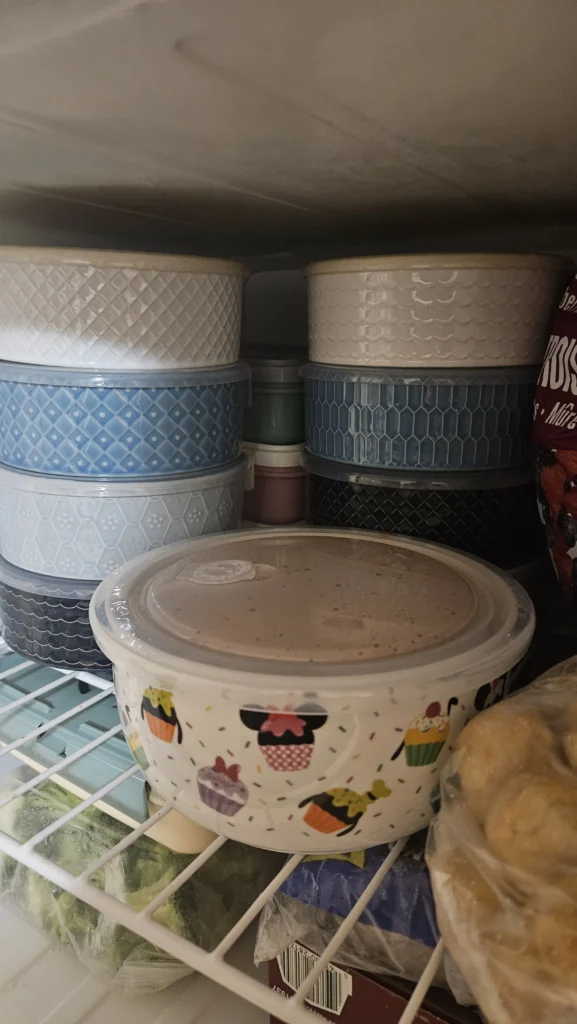
    A freezer showing bowls of Ozject's 8+1 chilli, prepared and ready for the next two weeks of work.

    I put the chilli into meal prep bowls I got from Costco and freeze them for up to two weeks. Remember to take the chilli out and put into the fridge the day before you are going to eat it.

    When researching this article, I came upon some information about food hyperfixation, and while I knew I had a problematic relationship with food, I now have a definition:

    “Food hyperfixation, eating the same meal, snack, or brand over and over, is common for Autistic people. It’s often about sensory safety, routine, and predictability” (Wilkins).

    Before I realized I could eat my chilli, or my homemade butter chicken, every day, I found my food hyperfixation focused on pizza, burgers, and other junk food. It took a lot of self discovery to find healthier foods I could fixate on. Unfortunately, most of those healthier options require enough energy to prepare them. Meal prep can help, but if I can’t build up the energy to do it, it’s far too easy to just have a burger.

    Executive Functioning

    There are plenty of days where I don’t want to cook. I don’t have the luxury of succumbing to my executive disfunction because I have kids who need to eat healthy, home-cooked meals at least some of the time—I strive for most of the time. I don’t really like using the word luxury there, but it’s true—on pizza days, I get a break. And it’s really nice.

    I find that with meal prep, it helps a lot to start a new batch before running out of what I have in the freezer. If I do 12 bowls of chilli, I’ll start prepping butter chicken when I have two to three left. This gives me a window of two days where if I don’t feel like cooking, there’s always tomorrow.

    Lydia Wilkins describes the process of cooking as, “… Never one task. It’s dozens, layered on top of each other. Plan, prep, clean, sequence, remember, shift, re-plan, regulate” (Wilkins). This process can be quite daunting, but in my case there are some high points. I love the cleaning part and the eating part. I love seeing 12 bowls of food lined up on my counter—a visual reward for all the hard work. When I’m struggling to motivate myself to cook, I think about the things I like about cooking.

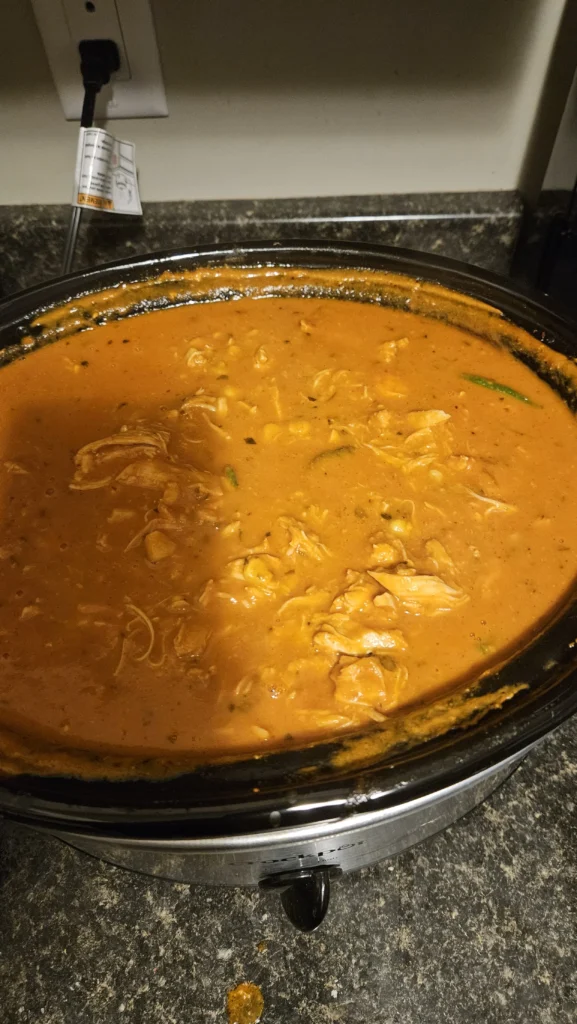
    A crock pot full to the brim with butter chicken.

    I meal prep a lot of chilli and butter chicken. Chilli is an opportunity to try new beans, while butter chicken is an opportunity to try new vegetables. I recently experimented with potato and green beans. The beans were a bit of a miss, but the potato added a really nice creaminess to the sauce. Potatoes are a lot of work, though.

    One of the concepts of healthier eating that I really enjoy is, “add, don’t subtract.” I once tried to meal prep chicken alfredo penne by substituting cottage cheese and greek yogurt for the cream and parmesan in alfredo. What a disaster. It was bitter, sour, not creamy at all. I ended up throwing it out. Instead, by the concept of “add, don’t subtract,” I add vegetables, either on the side or in the sauce. Spinach, corn, and green peas work really well in the sauce, while steamed broccoli and cauliflower work great on the side. By adding the vegetables, I have less of the heavy cream, cheese, and pasta. But, I still get to eat food that I enjoy.

    Another meal prep disaster was when I tried to meal prep copycat Domino’s stuffed cheesy bread. When I baked it in the toaster oven at work, the dough wouldn’t fully cook before it burned, so I ended up eating a lot of raw, burnt dough. I still ate it, because I didn’t have the energy to prep something else that week. “And for many Autistic people, it’s about survival, not aesthetics” (Wilkins).

    If you struggle with coming up with recipe ideas, there are some great resources online for autistic and sensory-friendly recipes.

    Mix ‘n’ Match

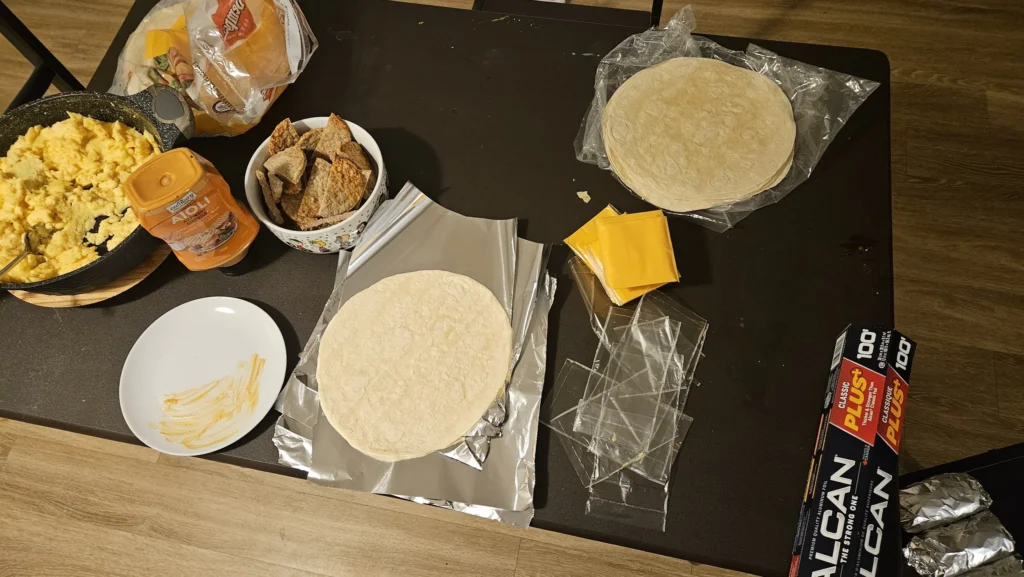
    A table filled with the ingredients for meal prepped sausage egg and cheese wraps.

    When I prep breakfast sandwiches, I like bacon, egg & cheese or sausage, egg & cheese. To add a little variety, I’ll use two different cheeses in addition to two different meats. So maybe one day is bacon, egg, & cheddar. Another day is sausage, egg & swiss. I wrap them without labels so I never know what I’m going to get. I also make sure one or two have both bacon and sausage, and call those “treasure sandwiches.”

    Both my butter chicken and chilli recipes work as one-pot recipes. One-pot recipes simplify a lot of steps and make clean-up easier. Other blogs have made similar recommendations: “So can using simple techniques like making one-pot or freezer-friendly meals in advance” (Laube)

    When I make butter chicken, I usually put all the same vegetables in the batch. But I change the starch, since I usually prepare that on the day I eat. So on Monday, I’ll have butter chicken on rice. On Tuesday, it’s butter chicken on naan. And on Wednesday, it’s butter chicken penne. I find it too difficult to mix and match proteins—so I don’t prepare some chilli and some butter chicken. I usually only have the energy to prepare one thing—so I just eat the same thing for two weeks.

    Stash of Non-Perishables

    Although we should all probably be eating less packaged, boxed food, it definitely has a place in the autistic kitchen. I am a big fan of Kraft Dinner, frozen chicken burgers, frozen burritos, frozen pizza, ramen, and Hamburger or Tuna Helper. These ten-minute treats can prevent me from eating fast food, so in the grand scheme of healthier eating, they are helping. Like before, add, don’t subtract. It’s not about never having Kraft Dinner again, it’s how can you make it better for you? I don’t like to mess with my Kraft Dinner, so I’ll usually have steamed vegetables either before or after to offset the health cost of the food. And I’m not the only one who likes Kraft Dinner.

    Canned soup and chilli is also great, and even things like TV dinners or other frozen meals can fit into an otherwise mostly healthy diet.

    Celebrate Your Wins

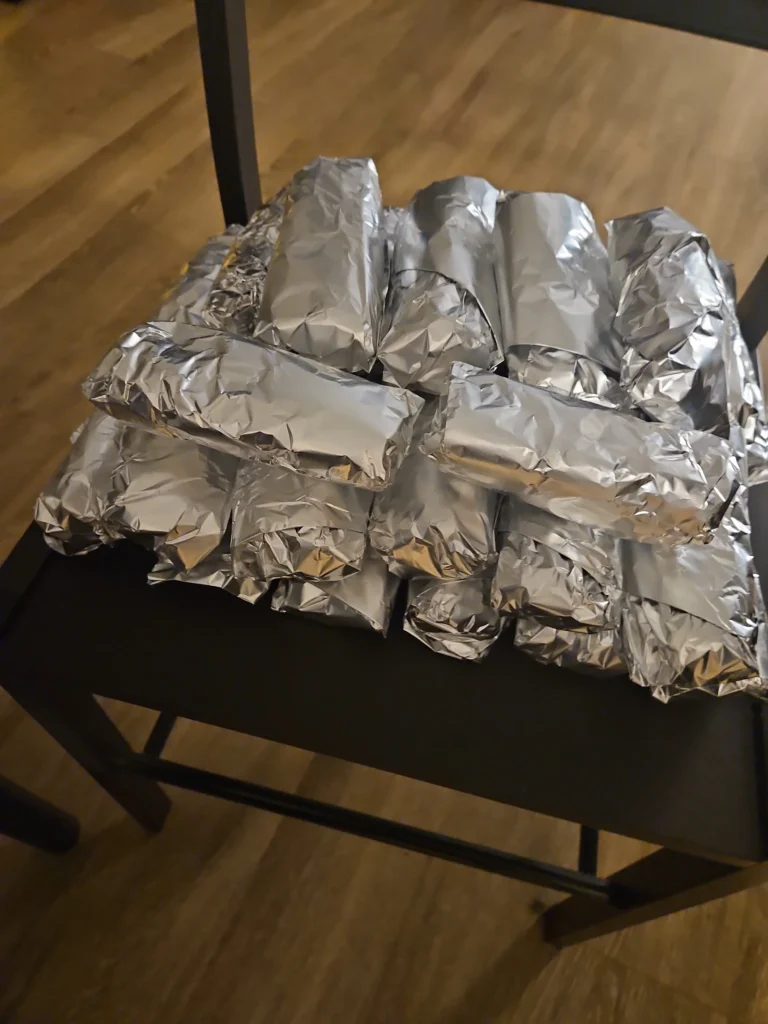
    Tinfoil-wrapped sausage egg and cheese wraps.

    It’s important to recognize when you’ve done well. Often, my celebration is to eat some of the food I’ve prepared for the weeks ahead while it’s fresh. So I’ll prep 12 bowls of butter chicken, but I’ll eat one after the work is done, freezing the remaining 11. Or, if I have leftover eggs, I’ll make one super sandwich and eat that once the rest are wrapped.

    No matter how you celebrate positive achievements, make sure you do. Your reward of having healthy, delicious food every day is great, but if you don’t find a way to capitalize on the positivity you generate from the meal prep, you’re at risk of wasting valuable resources that you could bank for later in the day. Got a phone call and that kind of sucked? Hey, at least you meal prepped butter chicken today, you superstar. Ride that wave through all the phone calls.

    References

    1. Wilkins, Lydia, “Making the kitchen more accessible when you’re Autistic.” Dec 1, 2023. Tiimo App.Accessed Oct 29, 2025.
    2. Laube, Aly. “Cooking tips for autistic adults.” Jun 25, 2024. AutismBC. Accessed Oct 29, 2025.
  • Design a Neuro-Friendly Streaming Setup: Tools to Tame Sensory Input

    Design a Neuro-Friendly Streaming Setup: Tools to Tame Sensory Input

    Every autistic person’s relationship with sensory overload is different. I struggle to go grocery shopping due to the bright fluorescent lights and loud overhead music. I mitigate this by wearing noise-cancelling headphones playing peaceful music or nature sounds (usually thunderstorms).

    When streaming, I have a sensory-friendy alcove with everything I need to stay comfortable. I have sound absorbing panels on my walls, soft LED key lights, another pair of noise-cancelling headphones, and a desk with more than enough space that I keep somewhat organized.

    Below are some of the strategies that I’ve been using since I began streaming. I’m always on the lookout for better options to manage uncomfortable sensory inputs, so if you have any to share, the comments were built for you.

    And, I often write my blog posts while live on Twitch. You could share your tips during a live stream. Check the schedule here.

    Lighting

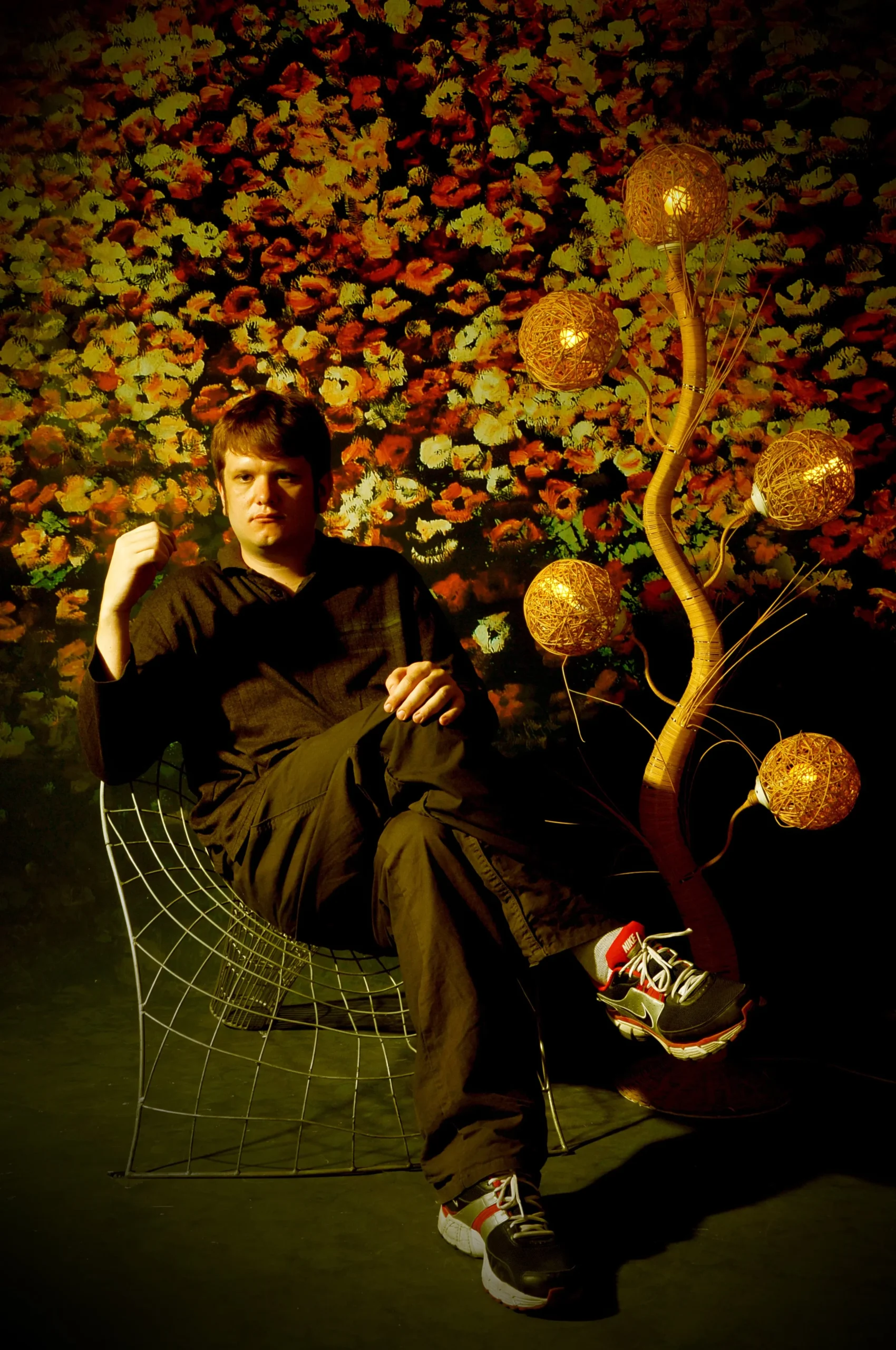
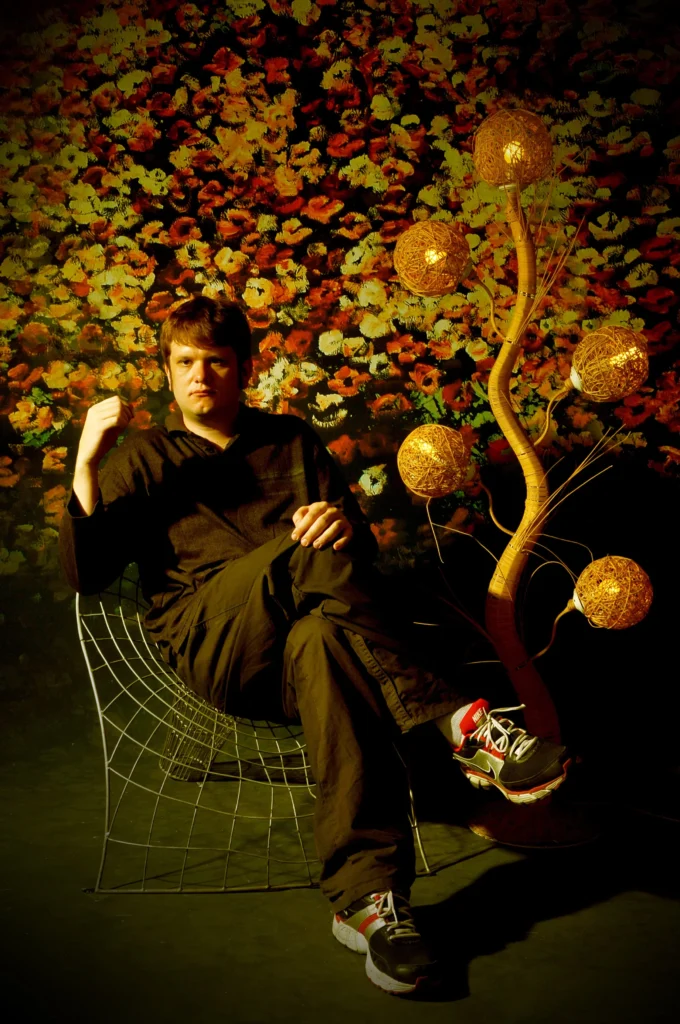
    An old photo of Ozject in his mid-twenties, sitting in a wire chair with autumn colours and an abstract lamp beside him.

    Lighting plays a critical role in making your camera look good. If you’re not streaming with a camera, I have previously said that “Your Camera is What Creates You,” in my post on unmasking and authenticity. If you still decide not to use a camera, lighting won’t be as important—though you should still make sure you don’t have bad lighting that interferes with your stream, such as direct sunlight, bright overhead lights, or lamps in your peripheral vision.

    For everyone else who is using a camera, whether that be a Logitech C270 or a Sony A6700, lighting is everything. Almost. Audio is pretty important too—arguably the mostimportant. But I want to emphasize lighting in this section.

    Diffused Light

    There are many options out there for stream lighting, but the consensus has always been soft, diffused light is best. This can be as simple as a sheet of paper over a work lamp from Home Depot, or it can be an advanced option light an Elgato Key Light. You can also get studio-style softboxes, though they are huge and difficult to manage in a small space.

    I use an Elgato Key Light and an Elgato Key Light Air. I understand Neewer has caught up to Elgato in the quality and functionality of its key lights, but the price is far less. I cannot speak to the longevity of Neewer products, but I’ve had my Elgato lights for years now and they are still going strong.

    I prefer lighting solutions that include adjustable warmth settings. I typically use 3500K, though sometimes I want to shift that to 5700K to help me stay awake. I tried to find some research to show how different temperature lights assist with different tasks. What boosts productivity? What boosts alertness? What relaxes you? And there’s lots of information out there, but none of what I found cites valid research. Most of my search results came back with websites that sell lights, and this isn’t something that I need to cite, so I’m giving up here on finding a source to back that up.

    Monitors

    I have a three-monitor setup, so there’s a lot of secondary light around me when streaming. I keep my main monitor bright because I’m gaming on it, but I typically dim my left and right monitors so I don’t have bright monitor light from all angles. My main monitor sits around 70 brightness, while the left and right are between 30 and 40 each.

    Minimalism

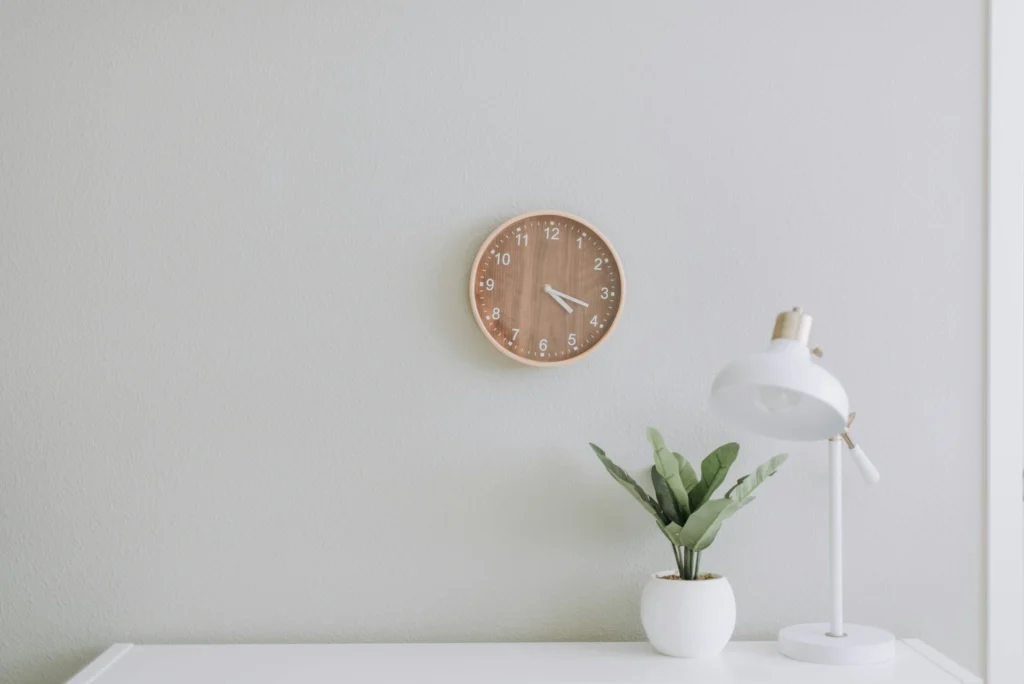
    A stock photo of a minimalist desk with one plant, one lamp, and a clock behind the desk. A white desk with a white wall behind it.

    Also in my authenticity and unmasking post, I mentioned minimalist overlay designs, avoiding flashing or loud alerts. My follow alert on Twitch is a recording of my own voice saying “Welcome,” and a pop-up of me drinking from my OzMug that happens off my main screen. I don’t get a lot of bits of subscriptions yet, so I haven’t had an opportunity to customize those alerts. But one of the things I’m always on the lookout for is ways to make alerts less intrusive while keeping them entertaining for myself and viewers.

    In gaming streams, my overlay is simply the game plus my camera—using a green screen to minimize the impact on the game scene. In writing streams, I have Pages, Lofi Sessions, and my camera. Very simple, nothing fancy.

    Audio

    Audio applies to the sound the creator hears as well as the sound the stream hears. Audio is the actualmost important element to a good stream. Every sound, from your voice to your gameplay and alerts needs to be perfect. Bad audio will lose you more viewers than any other problem with streaming.

    For you, audio problems could be alerts that cause jump scares, misleading sound effects (from something like Sound Alerts or Blerp), or a new Alert Box that you’ve just set up but didn’t realize the sounds were different and when someone followed you it scared the hell out of you. That may have happened to me once or twice.. or more.

    Active Noise Cancellation (ANC)

    Since my autism diagnosis, one of the greatest tools I’ve found was active noise cancellation. When I go out, I always have my Sony XM4s with me, and when gaming or streaming, it’s the SteelSeries Arctis Nova Pro Wireless. Although the ANC on the Nova Pro Wireless isn’t nearly as good as that of the XM4, because I’m at home, I can control many more elements of my environment, so it’s enough.

    Sidetone

    I cannot stand the feeling of speaking with headphones on and being unable to properly hear myself. Sidetone is when the microphone in your headset feeds itself back through the speakers so you can better hear what you’re saying. It prevents that phenomenon where people raise their voice because they’re wearing headphones. It does interfere with ANC a little, because the microphone is feeding sound back through, but it’s far less troubling than no sidetone at all. Most headsets with ANC should have a way to control this.

    Volume Control & Balance

    One of the most challenging settings I’ve dealt with is advanced audio properties in OBS. Finding the perfect volume for my game, my music, my voice, and my alerts has been an ongoing mission since I started. And your perfect settings may be vastly different from mine.

    My Xbox gameplay input is set to -7.0 dB, while my alerts are -11.0 dB. My gameplay also features sidechain compression (also known as audio ducking). I do this so that the game volume can be sufficiently loud when I’m not speaking, but when I speak, the game volume drops to let my voice be clear and easily heard. This also makes it less jarring for viewers when ads play, as the volume is close to the ad volume—unlike streamers who set game audio to 50% and then ads blast your ears.

    Beyond the balance for your stream, you need to find the right balance for yourself. Elgato’s Wave Link software can be a good option for this, as it includes independent volume controls for each input and separate controls for monitoring and stream output. This can be great when playing music, as you can have it quieter for yourself and louder for your stream, or vice versa.

    Alerts and Extensions

    Alerts are an exciting element to streaming and they can be a lot of fun. However, they can also be distracting or overstimulating. I am in the process of adjusting my alerts to be recordings of my own voice, but the process takes time as it needs to be something I don’t mind hearing a lot of.

    Twitch offers a lot of fun extensions that can make your stream more interactive or more chaotic. Some offer additional information for games like Dead by Daylight, Destiny 2, or Apex Legends. Others, like Sound Alerts and Blerp, allow viewers to spend channel points or bits on sounds and/or videos to play over your stream. I’ve seen people set up jump scares specifically to give their viewers an opportunity to scare them. This is great—for the people who want it. I’ve tested it, of course, and immediately realized it’s not for me. Give me my minimalist setup every day, and leave those other features to the people who find them fun to use.

    Microphone Filters

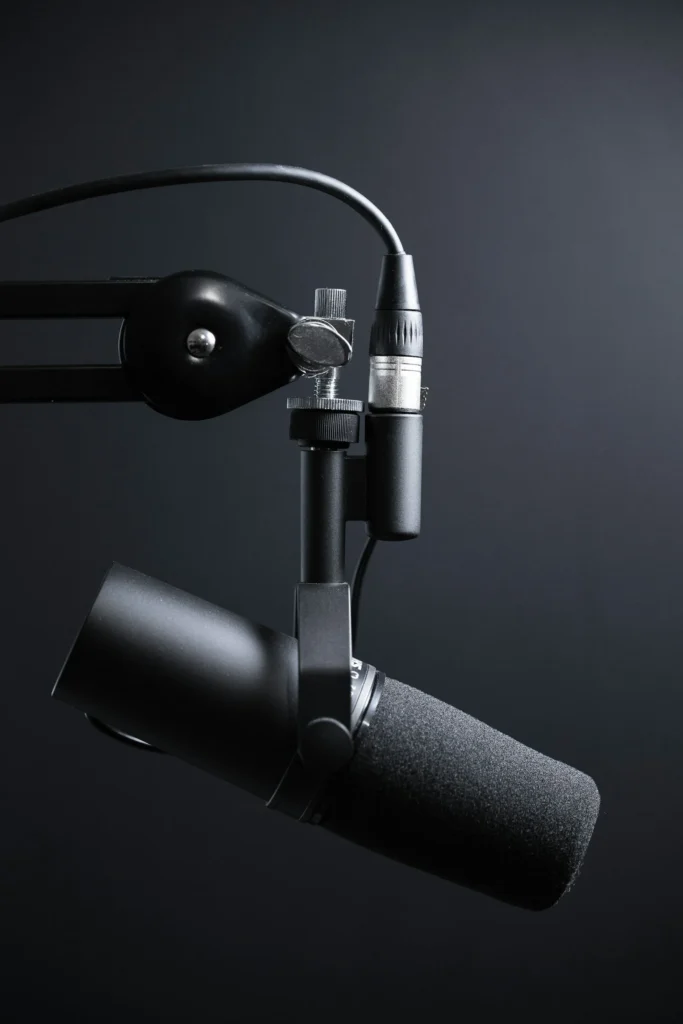
    A close-up of an XLR microphone.

    Your microphone allows you to speak directly into your viewer’s ear. With the right filters or plugins, you can slide right up beside them and whisper into their ear. I use VST3s through the Wave Link software to adjust the sound of my Shure SM7B.

    The VSTs I use are Renegate, RoughRider3, T-De-Esser 2, and TDR Nova, and I’ll show my settings in a gallery beside this paragraph. Settings will be different for every voice and every microphone, so this will be a labour-intensive task for any streamer. In addition to the VSTs I use, I also use Elgato’s Voice Focus feature—now (just this week) offered as a standalone VST and not tied to an Elgato audio product. Elgato W there.

    Within OBS, many filters exist if you don’t have access to VSTs—noise suppression, compressor, noise gate, and limiter. Even with all my filters in Wave Link, I still keep a limiter filter in OBS to make sure my microphone never peaks.

    With an Nvidia GPU, you may also have access to Nvidia Broadcast, which offers audio processing like Studio Mode, Noise Suppression, Room Echo Removal, and other features. I used this when I was streaming on my PC—but now that I’ve moved to my Mac, I’ve switched to Elgato Voice Focus. However, even before moving to a Mac, I preferred Voice Focus’s performance over Nvidia Broadcast.

    Physical Space

    The space you occupy needs to be conducive to your focus and success. For many, a messy workspace causes distractions, frustration, and the feeling of being lost in the clutter. But there’s nothing worse than cleaning your desk beforeyou do some creative work.

    Clean Your Desk

    If cleaning your desk is a task you’d rather avoid, do it the day before you plan to work. Do it on the weekend. Do it during scheduled cleaning time when you know that you don’t need to accomplish anything else for at least an hour after. Listen to music, put on a podcast. Whatever it takes, you’ll feel better once you sit down to a clean, uncluttered desk.

    Consider your Background

    Content creators who show their face have many background options available today. A physical green screen and proper lighting can be set above your gameplay, offering minimal distractions from the gameplay and making you the focus of attention, rather than a Sailor Moon plushie in the background. But maybe Sailor Moon is your vibe, and you want to showcase your collection of Sailor Moon Live Action DVDs—did you know they made a live action Sailor Moon show?

    If you aren’t using a green screen, your background needs to be deliberate and carefully staged. If behind you is just a messy room, clothes strewn about, mismatching couch cushions, or a pile of dirty dishes, consider the message that background sends your viewers.

    Today, there’s not always a need for a physical green screen. Again, with an RTX GPU, you have access to Nvidia Broadcast and its virtual green screen option, which works surprisingly well in its current version. It does take resources away from your GPU, so your stream could be impacted if you are trying to play games on the same PC you stream on.

    The Importance of Comfort

    An old photo of Ozject sitting in a chair thinking thoughtfully.

    A few things can make or break your comfort. Your chair, your clothes, your accessories, even things like room moisture.

    Gaming chairs are the biggest scam to gamers since the Atari Jaguar. They’re often manufactured with the cheapest parts and offer poor to middling lumbar and neck support. A good quality ergonomic chair rarely costs more than a branded gaming chair, but will vastly outperform it. When you go chair shopping, skip the Gaming Chair section and go to Office Chairs—your back, your legs, and your neck will thank you later.

    The clothes you wear need to be comfortable. I struggle with polyester and I can’t even touch most microfibre—luckily microfibre isn’t really used in clothes. Most of the time, when streaming, I’m wearing one of my ten grey cotton t-shirts, though recently they’ve gone from 100% cotton to a cotton-poly blend so I’m on the lookout for a new brand. I also wear my Noisy Grass Hoodie, which is also a blend, but it’s 85% cotton instead of the 60% of my t-shirt. Note from December 2025, the original Noisy Grass Hoodie has been discontinued on Printful’s website, so it’s been substituted by an 80/20 blend instead.

    Since I stream with a controller, I don’t typically have idle hands. Sometimes when waiting for a match to start, I might put the controller down, and I like to have something I can manipulate with my fingers—a fidget toy, if you will. I don’t have any actual fidget tools, though. I have a small pair of scissors, a screwdriver, a few pens.. anything I can spin or do some repetitive action on—so snip snip the scissors or twirl the screwdriver or pens. Many stores sell fidget tools now, so it should be easier than ever to get a stress ball, one of those popping plastic toys—they even make a bracelet popper now.

    The controller you use matters too—does it have comfortable grips? Clicky buttons? Good vibration? I’ve used a variety of controllers, but my favourite so far has been the Gamesir G7 Pro. My only complaint is it doesn’t support wireless on Xbox—though I guess that’s coming in a new controller later this year.

    Similarly, your keyboard and mouse should be comfortable. I like clicky keys, but not too clicky. Since moving to a Mac, I’m using a Magic Keyboard, which is a little light on the clicks, but still satisfying enough. On Windows, I was using a Corsair K100, which definitely won in the clicky category, but was also super bulky and the pads on the bottom of the wrist guard melted off in the Toronto summer heat. At over $300, that’s pretty frustrating. And the glue residue all over my desk that would sometimes rub onto my wrists. Let’s just say I’m very happy I moved to Mac.

    Distractions

    Finally, in your physical space, where does your cell phone live? Is it on silent, or is it going to buzz and play Dua Lipa’s Levitating when you get a call? If your cellphone is likely to cause distractions, how are you going to handle that? If you have a family who needs to be able to reach you, you may not be able to. But how do you avoid those necessary calls or texts from derailing you and getting you back on task?

    Being too hot or too cold can be their own distractions. How do you handle fluctuating temperatures during a long session? Generally, I stream with my window open in the winter, or a fan in the summer, to make sure I’m as cool as I can handle.. it’s easier to put on a sweater than to take one off on camera. Especially a pullover where I’m too stubborn to take my headphones off.

    Software

    I have found software issues to be my number one causeof shortened stream durations or loss of focus during creative time. In fact, the moment I began this section, my Stream Deck software crashed, and because my Stream Deck manages my audio, it stopped my music from playing and froze MacOS’s entire audio settings section in System Settings. The computer held me hostage, as it wouldn’t restart, and since Stream Deck runs in the taskbar, I couldn’t Force Quit it with Command + Option + Escape.

    Anyway, now that I’m back.. your software is going to break, crash, or fail, and you need to be prepared for it. You’re going to get a blue screen, you’re going to accidentally close OBS while live. Something will go wrong,and it’s important to be able to bounce back when that happens, and not fall into a pit of despair.

    OBS has a testing feature integrated with Twitch that will allow you to verify that your settings are correct. It’s not great, as it won’t show you your stream, but it at least lets you verify that you can go live. Combined with tools like TwitchTest and Twitch Inspector, you can hopefully troubleshoot any minor issues before you have enough experience to troubleshoot on the fly.

    If you’re working with a fresh OBS install, whether capture card or streaming on your gaming PC, you may be capturing all Desktop Audio by default. This means every Discord message, every email, and any sound that plays in your browser is going to go through to the stream. The first thing I do on a fresh OBS install is mute Desktop Audio and manually add any audio sources I dowant to capture.

    I don’t use desktop notifications, but if you do, and you capture your entire screen, those will also pop up. When your favourite creator on OnlyFans sends you the custom video you paid for, well.. oops. Also, like updates or emails with your real name that could be shown.

    Tools like the Stream Deck can be valuable. I use my stream deck to control audio sources, capture my replay buffer, run ads, and monitor my CPU load. I also have some setup buttons to automatically open my browsers to the stream monitoring services I use, and a button to use as a welcome message—though I need to change that one.

    Beyond that, you can use a Stream Deck to mute your microphone, change scenes, play sounds, videos, or even change the lighting in your background (with the right tools/setup).

    Finally, there are some big advances in audio software. Elgato has Wave Link, though it’s locked behind owning one of Elgato’s audio products—a microphone or a Wave XLR. Wave Link lets you install VSTs directly onto your microphone and it can be used to route every audio source you use, with separate volume controls for you and for the stream. SteelSeries also offers Sonar, but the two times I installed Sonar on Windows, as soon as I restarted I had no audio on any source until I uninstalled Sonar. I’m sure it was a user error, but since I have a Wave XLR, it made sense for me to just use Elgato’s solution.

    That’s a Wrap, Folks

    These are the few thoughts I had on this topic. If you’ve found some ways to mitigate overstimulation and avoid sensory problems, please do comment below and share them with other readers.

  • How Unmasking Builds Authenticity

    How Unmasking Builds Authenticity

    If you know you’re autistic—either gone through professional diagnosis or you self identify—then you’re probably at some stage of unmasking yourself. My diagnosis came in January 2024 and, although I knew before that, my journey really began after I got it in writing. I was working full time and masking heavily both at work and at home. Though I’ve been streaming since 2017, I never realized how detrimental my masking was until I severely burnt out in 2021 and deleted all of my social media and streaming accounts. When I finally built up the desire to return, I had to start from zero again.

    Masking is “a conscious or unconscious suppression of natural autistic responses” (Bennie). In primary school, I was told I was “too weird” by classmates and “too passive” by teachers—so, in high school, I tried to stop being weird and passive: I made friends, joined dance club, and got a girlfriend—kind of. But eventually, my mask fell short and my school friends became less friendly. I couldn’t hold my girlfriend’s hand as I had just learned that physical touch was uncomfortable for me. This led to more bullying and isolation, and eventually led to me quitting school altogether.

    At work, masking meant I went over and above to make people happy—extreme people pleasing. Often at the expense of my own happiness as I would take on too many projects. Since I refused to submit anything short of perfect, I would work under tremendous, mostly self-inflicted pressure. I’d get everything done with a fake smile, never revealing the mental torture that I was under to get across the finish line. There was a measurable pattern where I would work until I burned out, then I would quit until the burnout subsided before starting it all over again at a new job.

    In streaming, I fell into the trap of “community building” above all else. People will tell you that you need a Discord server. You need a donation page. You need fancy overlays. Oh, scratch that, overlays are old news and now you need a minimalist design. Remember the tip cup? That thing was annoying as hell. In early 2021, my average viewers on Twitch were between 20 and 25. I ran an active Discord which I was moderating alone because that’s how I do it.. take on everything myself. After a particularly heinous hate raid, I deleted the Discord server and erased my presence from the Internet without a word to even my most devoted community members.

    Minimalist is Okay

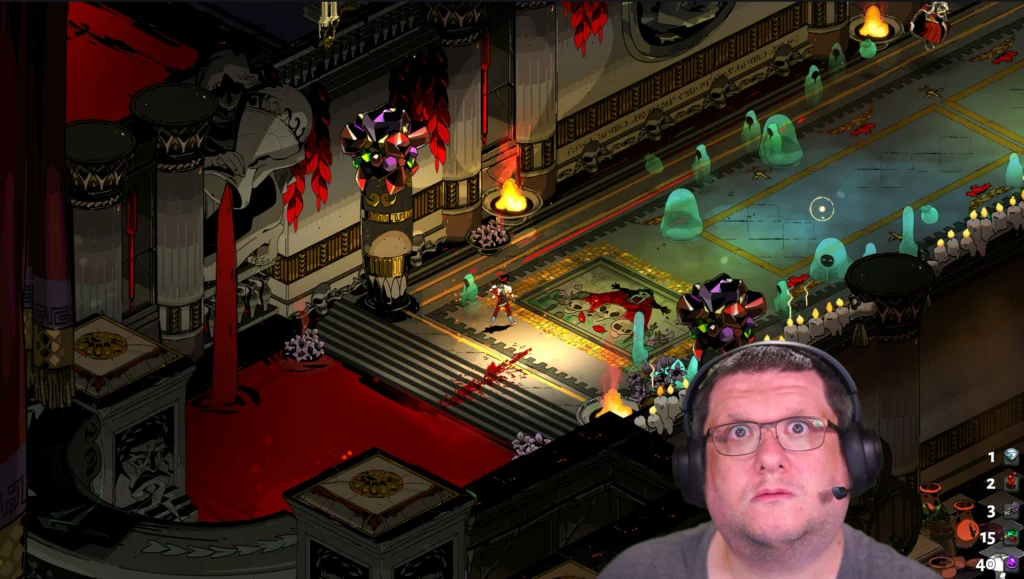
    A screenshot of Hades while Ozject streams.

    Tip cups aside, there is no need for fancy overlays in 2025. If you’re streaming video games, the focus is split between you and the games. There are elements that can be valuable and interactive without being distracting. I like a minimalist alert box. I also have my camera—and nothing else. No camera frame and no noisy extensions. They can be fun, but they can also be overstimulating and overwhelming. Especially if you’re fairly new to streaming, adding more features is never my recommendation. Stick to simple and experiment once you’re comfortable.

    Your Camera is What Creates You

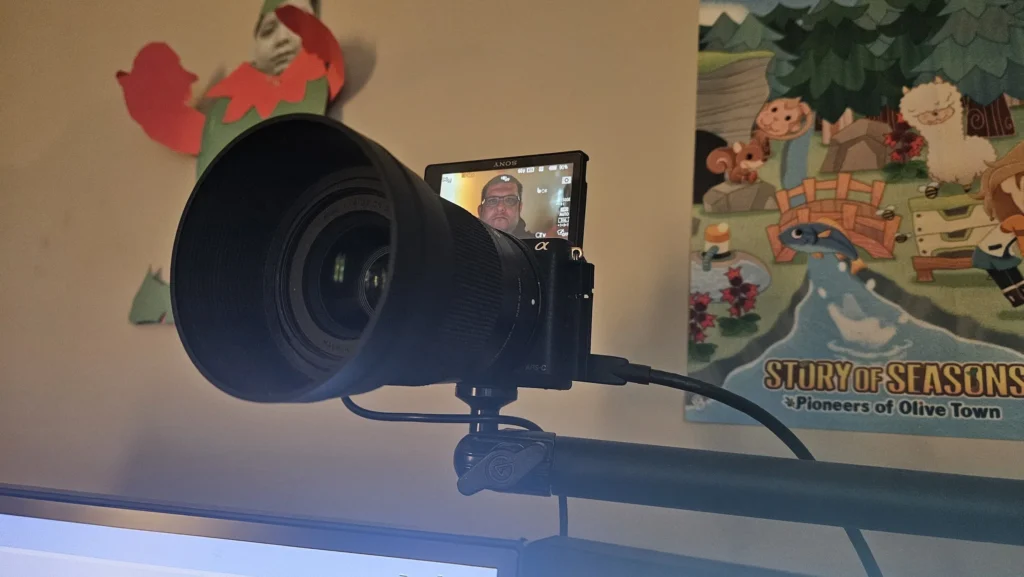
    A close-up of a Sony a5100 camera, which Ozject uses as his stream camera.

    What I mean when I say your camera creates you, is that your camera provides your viewer with a direct feed to you—your facial expressions, your imperfections, or your jaw-dropping beauty. Whatever you look like, the camera adds humanity and authenticity to your stream.

    With the popularity of VTubers and PNGTubers, we are learning that a persona representing yourself can still be authentic and impactful. Meaning you don’t necessarily need to put your true face out there for all to see. Although, in an article focused on unmasking yourself, the thought that someone would wear a digital mask is somewhat ironic. But since autistic masking is not wearing a literal mask, I think VTubing and PNGTubing are not contradictory to the idea of being your true self.

    What is hard to argue is the value of having a visual representation of you on the screen. If you are camera shy, PNGTubing is quite approachable without significant financial investment. In general, I feel like viewers are there to connect with the streamers who are streaming things they find interesting—whether that be games, hot tubs, or blog writing. It is harder to connect with someone when they are a disembodied voice. Like schizophrenia. But less scary.

    Social Media is Stupid

    Ignoring the fact that live-streaming platforms are a form of social media, let’s talk about the mental impact of maintaining a Twitter account, a Bluesky account, or a Facebook page.

    If you want to be successful on social media, you need to be active. Large companies hire social media managers, sometimes social media management teams, because they recognize the amount of work that goes into maintaining a relevant social media presence. How, then, is a small streamer expected to keep up? First off—you’re not. You’re never going to be Wendy’s on Twitter. But, there are still an overwhelming amount of tasks to perform to maintain a growing social media presence.

    A screenshot of a Wendy's tweet (though this is when they renamed to Tendy's), that says "Can't believe we got Travis Swift before gta6."

    First, you need to post relevant content regularly. It’s important to note that regularly does not always mean daily. Regularly means at a regular cadence that the platform’s algorithms can predict. YouTube has always been the easiest example of this, and is why creators who post regularly see the best results. Relevant content means it is high quality and original.

    Second, it cannot always be about you. If the only thing you ever post on Twitter is, “I’m live right now on YouTube, come check me out!” You’ll never see a single follower come over from Twitter. Reddit has the best rule on self promotion—the ten-to-one ratio. You should post ten things that are not about your stream or your content for every one post about your content. If you stream three times per week and post YouTube videos twice, you need 50 social media posts that are not about you, but are still high quality, relevant content, to hit that magic ratio. And, you need to do that for every platform that you’re a part of. And while some posts can certainly be copied between platforms, that’s not in your best interest, because each platform features a slightly different audience. What works on Twitter may not work on Bluesky, even though they are similar platforms. I have accounts on many social media sites, with username Ozject, but I am not good at maintaining any regularity in posting. I usually link to new blog posts, and once in a while I have a thought that goes on Twitter and Bluesky, but it’s really kind of a waste of my time as I don’t put in the full amount of work required to see any growth. What I should do is narrow down one or two platforms, focusing entirely on growing those. Maybe now that I’m finally writing that out, it’ll actually happen. I probably choose Bluesky and Facebook, but we’ll see. 

    Streaming as a Social Setting

    If you think of streaming as willingly putting yourself into a social setting, you might feel the urge to mask. However, it is my belief that autistic people who begin streaming do so knowing what the expectations are and being okay with them. After all, we are in control of our streams and therefore we control the flow of the conversation and the activities.

    When I’m playing an first-person shooter, like Apex Legends, I will often have viewers ask if they can play with me. Apex is a team game, but I find it very different playing with random people assigned to my squad than playing with people from stream. My answer to this question is always, “I’m not partying up right now, but I welcome stream sniping if you want to try and join me or kill me.” Setting this boundary allows me to refuse to put myself in a position I know will be uncomfortable for me—that is, the feeling that I need to be at my best because someone has chosen to join me—without completely shutting down what may be a genuine wish to play the game together. I’ve had people join and kill me, but I’ve also had people join and protect me—even when they were assigned to an enemy squad. And a few times, those viewers have been in my squad and we get to celebrate because they did it.

    There are some areas where you might find yourself masking. You might laugh at a joke in chat that you don’t fully understand. You might enter your chat with pre-written conversations or rehearsed answers to questions you expect. You may conceal your interests to appear more approachable and less autistic to your viewers. These are some of the masking techniques identified in Examples Of Autism Masking (Guy-Evans). What makes live content so special is the unscripted nature of it. I have deleted entire lines, entire paragraphs from this very article—but if you were in the live with me while I wrote it, you would have been able to see those lost words. That’s the experience we’re trying to share. Laughing at a joke that misses the mark or preparing a script for every viewer isn’t going to make you more authentic—it’s going to make you uncomfortable.

    Embrace the Crazy

    An old photo of Ozject when he was in his mid-twenties, wearing a red shawl in a winter wonderland backdrop.

    On the topic of crazy, here’s a picture from 15 years ago of a silly photo shoot I did to feel better about myself.

    In a previous article, I emphasized the value of embracing your special interests and making your stream all about that interest. In my case, my special interest is streaming. It’s the technology. The trends. The equipment. I love everything about streaming, even though I may not be the most entertaining person (I speak in a monotone voice, I pretty much never look at the camera, and I can’t make up my mind on a schedule or game to play long term). This puts me in an uncomfortable position for growth, because no two streams are ever the same.

    But, when someone comes into my chat and asks me about OBS settings, or microphones, or cameras, my eyes light up like Christmas and I can go on for an hour, forgetting that I’m playing a video game as I go over every camera I’ve ever used or thought about using, why I chose to use it or not, and what I would do if I were a new streamer now. Topics about streaming are my absolute favourite things to discuss while streaming.

    I think this may stem from when I was starting out, there was very limited information out there on how to stream. There was a lot of gatekeeping, and the hardware wasn’t that great yet—this was before NVIDIA made NVENC a leader in the scene. This was before Silicon Macs with dedicated encoder chips. Streaming was hard, and people weren’t really willing to answer questions. As I struggled, experimented, and learned, the scene opened up quite a bit. I remember Harris Heller being one of the first I saw who openly talked about settings and equipment, and soon after that, I was seeing it everywhere. I don’t like people coming into my stream and saying, “Hey, I’m live, come check me out.” But people who are here, talking about streaming, asking questions about my setup or looking for answers about their own—that’s what I like to see.

    This section is called “Embrace the Crazy,” and in just a few short minutes, I’ve written over 350 words about this topic. It’s safe to say that this is me embracing my own crazy.

    Find your crazy, and build your stream around it. At least during the early growth phase, you’ll find happiness and safety.

    Speaking of Safety..

    Stay safe. Existing without masks carries risks—because you may not be used to it. You may reveal identifying information about yourself without even realizing it. Take precautions, and if you’re going to script anything, it should be with the goal of keeping yourself safe.

    References:

    1. Bennie, Maureen, “What is autistic masking?” Jan 11, 2022. Autism Awareness Centre, Inc.Accessed Oct 3, 2025.
    2. Guy-Evans, Olivia, “Examples of Autism Masking,” Oct 30, 2024. SimplyPsychology.Accessed Oct 3, 2025.
  • The Power of Routine: How Structure Enhances Autistic Creative Output

    The Power of Routine: How Structure Enhances Autistic Creative Output

    Across the spectrum of neurodivergence we have chaos-loving ADHD people and structure-needing autistic people. When trying to harness creative energy, both sides of the neurodivergent coin must approach it differently. Speaking from the experience of an autistic person, I do my best work when I set a specific chunk of time aside for creative work and eliminate as many distractions as possible—after all, distractions break the hyper-focus that a good creative session needs in order to scratch that itch.

    What is Structure?

    For the purposes of this article, structure is any repeatable action that helps someone maintain a schedule. Working a full-time job is a good example. You might wake up at 6:30 AM, take a 15-minute shower, brush teeth for two minutes, spend five minutes making and eating avocado toast, seven minutes getting dressed, and 25 minutes to drive to work. This leaves you with 36 minutes of overhead in case your toast burns or traffic is slower than usual, and probably still leaves you 20 minutes to sit in the parking lot running through all the scripts you’re going to use to interact with your coworkers.

    When you apply the concept of structure to content creation, you can minimize distractions or disruptions and maximize your creative output because you don’t need to worry about anything else for that dedicated block of time. It does require quite a bit of planning and a good understanding of your own barriers.

    Hyper-focus as a Reward—or a Promise

    I find it easiest to get into a hyper-focus period of creative work in the mornings. I drop the kids off at school and then have around six hours before I pick them up. But in this same time, I need to do things like clean the kitchen, eat lunch, do the shopping, run errands, etc. On a day with no errands and no shopping, I’ll usually start the day with as close to two hours of content creation as I can. Knowing that I can spend that two hours, and then clean the kitchen and make lunch, and still have some time after lunch for other cleaning or tasks, or video or copy editing, I can work uninterrupted and be productive. This is what I call hyper-focus as a promise—I am taking a calculated risk that I won’t get sucked into a 6-hour session, and rewarding myself for control.

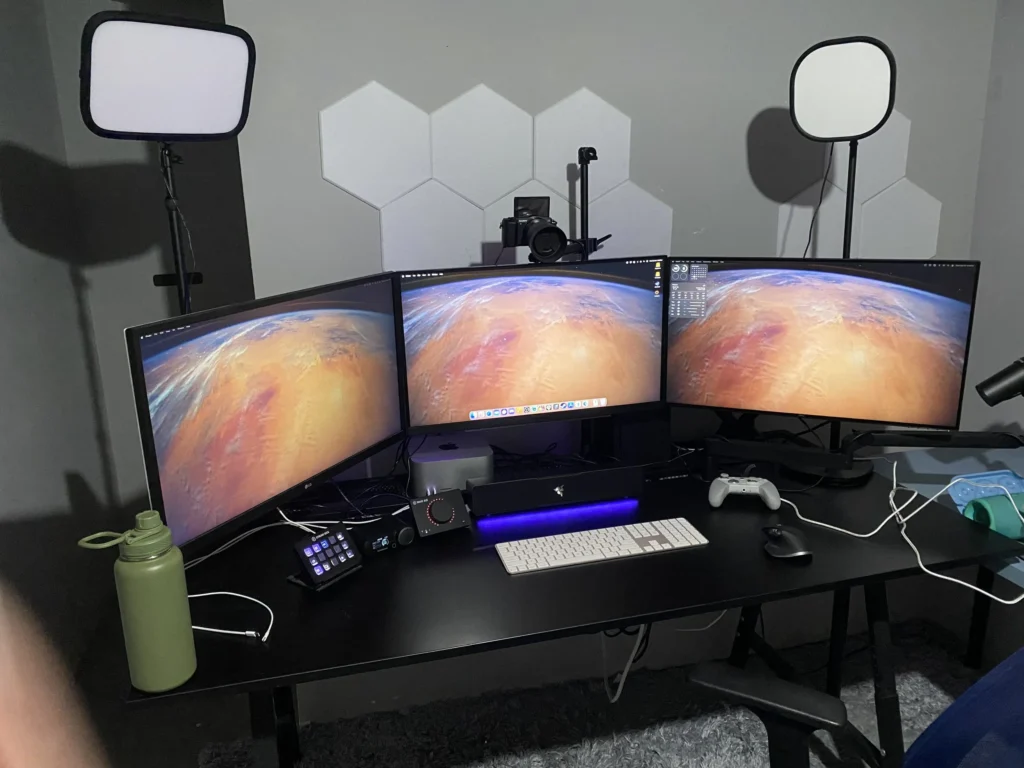
    A picture of Ozject's streaming setup--three monitors, some lights, a camera, and some assorted tools on the desk.

    On days where I need to do shopping or errands, I’ll approach it differently. I start my day with whatever tasks I need to complete and use the hyper-focus as a reward. As someone who struggles with an eating disorder, rewarding myself with something other than food is a huge achievement. I do shopping as early as possible to avoid crowds, I wear my noisy grass hoodie and noise-cancelling headphones to minimize the sensory overload. When I get home, I give myself around 30 minutes to decompress from whatever I encountered while I was out, and I make sure that 30 minutes is not spent at the computer. From there, I transition into a lighter type of creative work—maybe I tweak the website, do analytics work, research topics and ideas and start putting together source lists, and write opening paragraphs to some of my ideas. If inspiration strikes, I roll with it, but if not, I direct the less effective creative time to the important sub-tasks of running a website.

    Building a Routine

    Building a routine starts with scheduling as many things as possible in advance. Whether the schedule is daily, weekly, or monthly, knowing what needs to be done, and on which days, helps you build it out. I know that most grocery stores change out their sales on Thursday, so I usually set Friday as my grocery shopping day, with Sunday as my oops-I-forgot-cheese day.

    Setting a Stream Schedule 

    I schedule my Twitch streams in a staggered format that allows days for flex in between—at the time of writing, those streams are Monday, Wednesday, Friday, and Saturday, 6 PM to 8 PM PT. This balances the needs of having a family with my favourite activity.

    I have written before about the challenges in coming up with a schedule you can adhere to—after all, consistency is very important to growth on Twitch. If you check my first article, the times I set for my streams have changed since even then. I’m constantly refining my schedule and adjusting for changes, especially around my kids’ needs. The most recent change was that Monday and Wednesday used to be 5 PM to 7 PM streams, but I was finding it challenging to be ready by 5 PM, because dinner preparation may not be finished yet, or we might be outside riding bikes, or on a snack run. Moving the time to 6 PM increases the chance I’ll be on time and prepared. 8 PM feels a little late on a school night, but I’m still finished before the kids to go bed, so it’s been fine so far.

    My stream schedule is the most likely to get disrupted by factors both in and out of my control. This is why with each article I post, it seems like my schedule has shifted in some way. Olivia Guy-Evans says it well here, “A supportive routine makes life easier; a restrictive routine causes distress if it’s disrupted or prevents you from doing important things” (Guy-Evans, 1). There are few things more restrictive than a hard start time for a livestream when you don’t know what will be happening four Mondays from now. Adhering to a schedule is important, but not more important than your mental health.

    Meal Prep

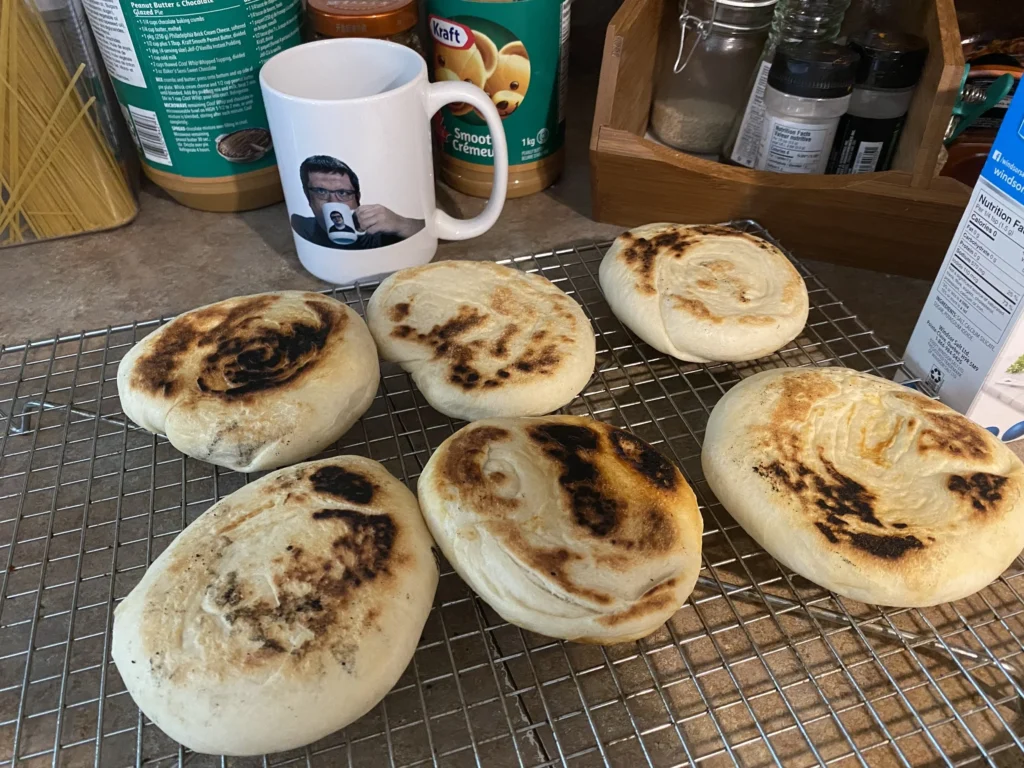
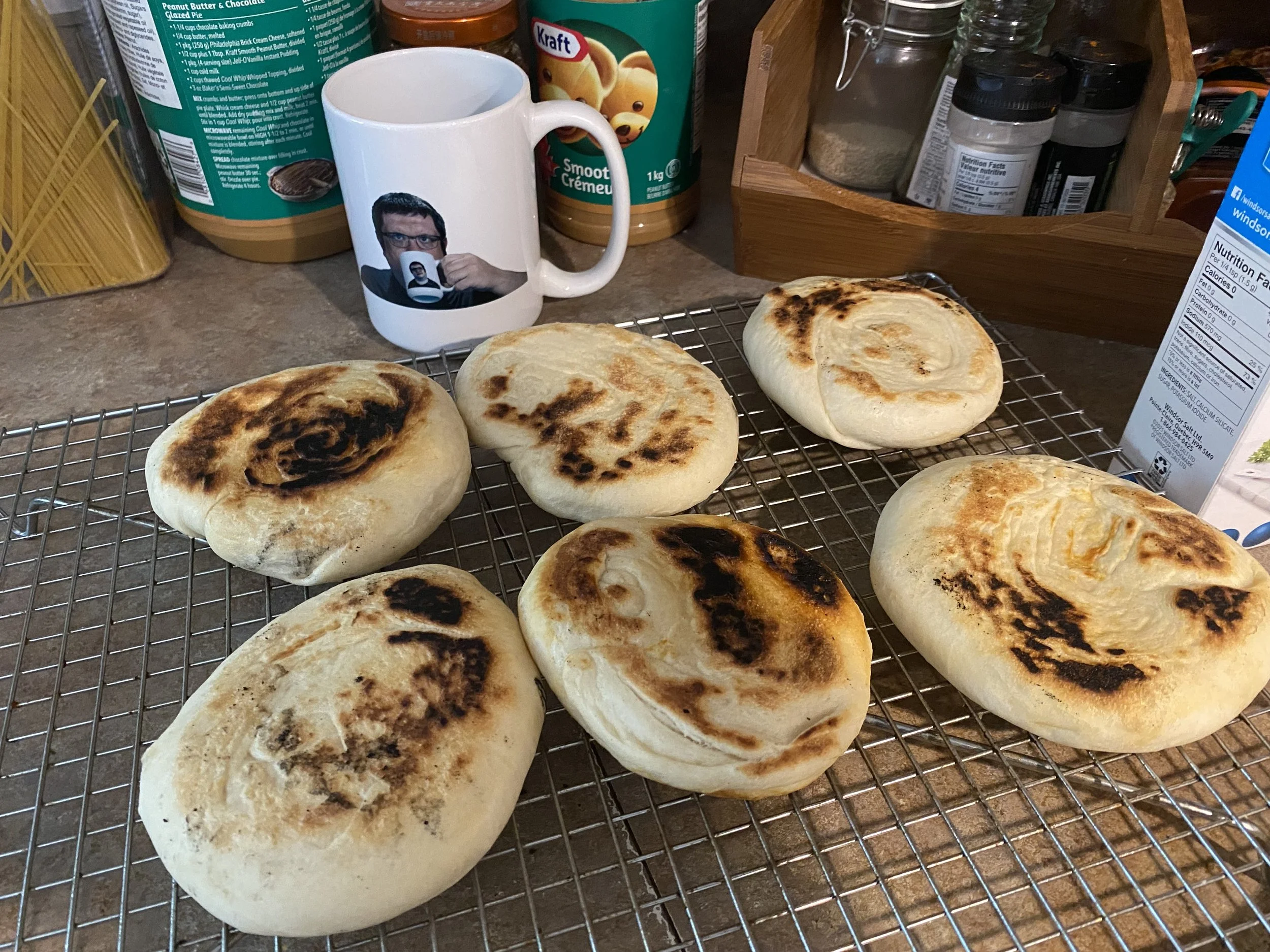
    A photo of some Chinese bread, called bing (like the search engine, but pronounced like "bean"), as the OzMug watches from behind.

    One of the advantages of my flavour of autism is that I can eat the same food every day for months and never get bored. Breakfast sandwiches, butter chicken, my signature 8-bean chilli, it’s all easy to prepare in bulk, freezes for weeks, and significantly reduces the time strain on preparing lunch every day. I’m going to put together some meal prep this weekend and hope to take pictures of the process and post my recipes as I do it.

    Avoid Time Killers

    There are a few things that will suck time from your day and you can never get it back. Reddit, YouTube, and TikTok are the risks to my own success.

    I enjoy using Reddit to get news and information about the things I care about. Currently, I’m subscribed to the Twitch, Xbox, and Elgato communities. The key to not falling down Reddit rabbit holes is I stay away from r/all during the day. Reading about the things happening in the world is a great way to lose hours of your day—and I’m not even American. In a similar vein, I stay off Facebook, Twitter/X, Bluesky, and other social media sites, because it’s too easy to fall victim to someone’s ragebait post. It seems like more and more people are building a platform on hate and negativity, and it can be hard to avoid that.

    I watch YouTube periodically throughout the day, but now that I’m doing my own content creation, every minute that I watch a video is a minute I’m not working on my own video. That said, videos need viewers, so I try to watch things that are educational, informational, or related to video games I play—you still need some time to relax! Most of my relax time, however, comes from TikTok. My feed is a combination of autistic creators, food creators, and gaming news. TikTok is extremely easy to fall into for too long, though, so I try and limit myself to times like waiting for water to boil.

    It’s difficult to schedule things like these, so instead I fill them into the gaps in the schedule where nothing is planned.

    Helpful Tools

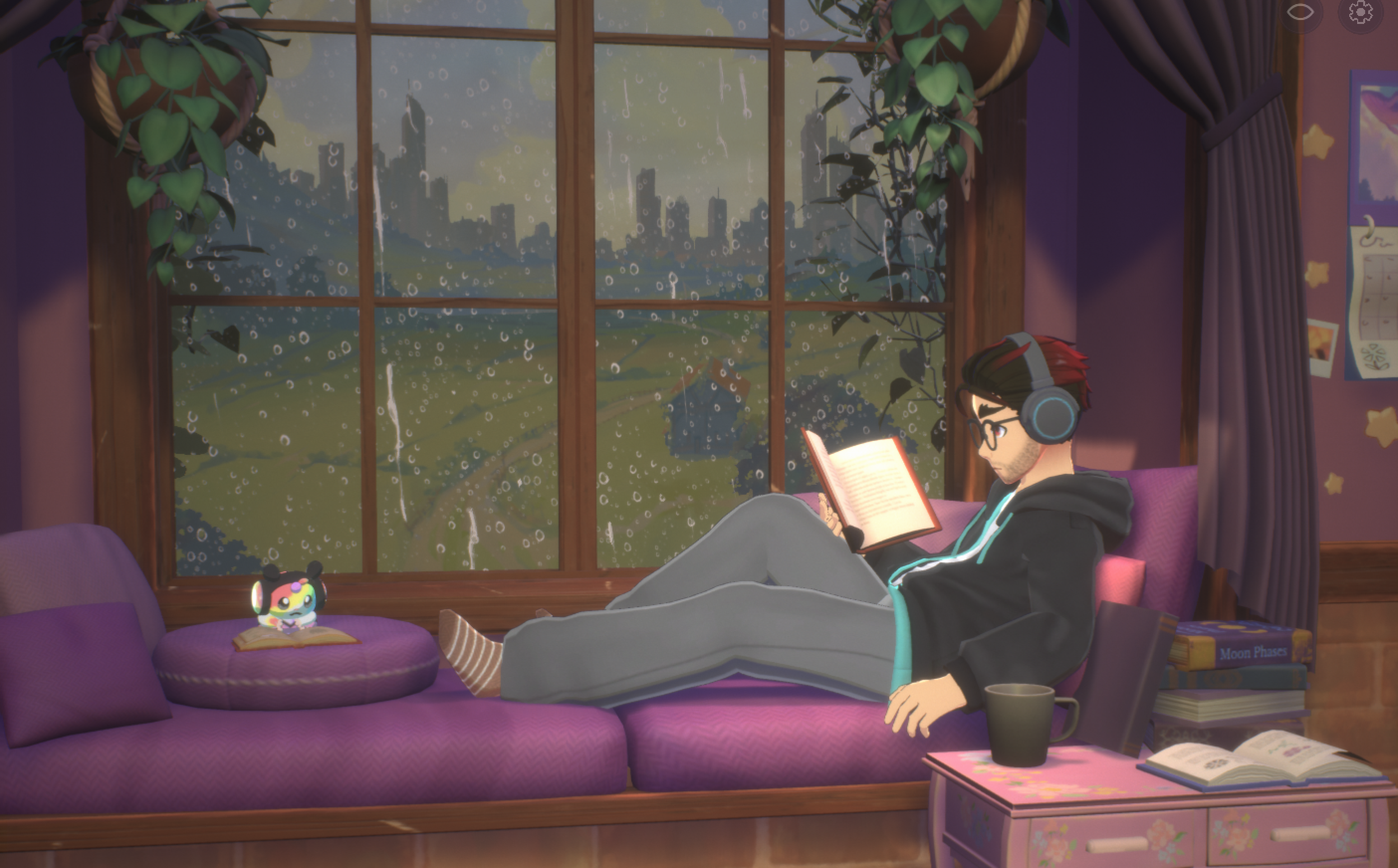
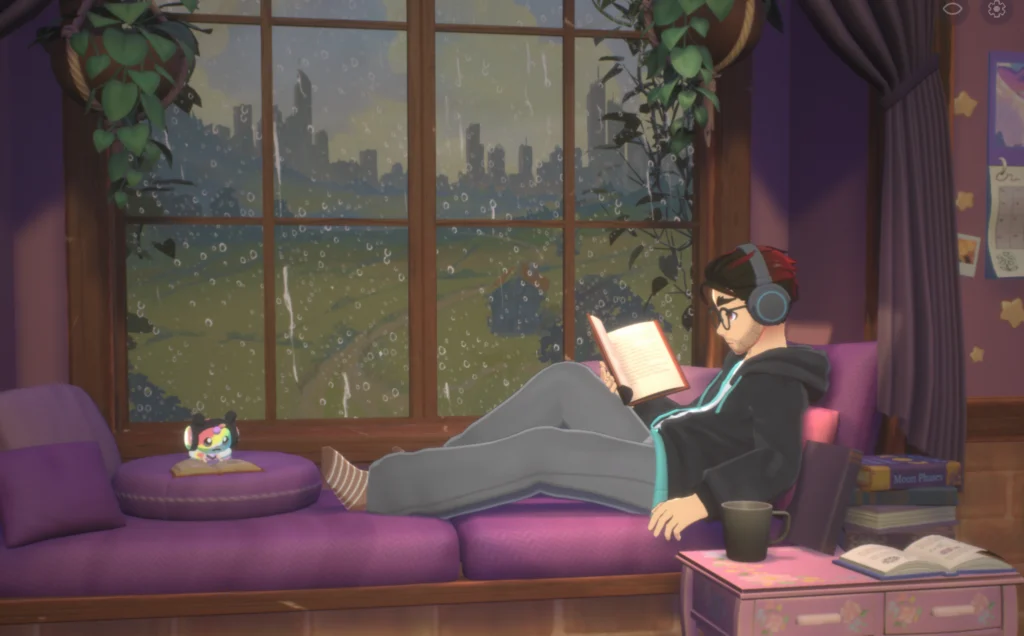
    One of the greatest productivity tools I’ve found is a game on Steam called Spirit City: Lofi Sessions. You create a character and sit them in a cozy room while Lofi tracks (stream-safe tracks, I might add). The game has features like a to-do list, journal, timers, and a productivity tracker. You can add ambient sound like a crackling fireplace, thunderstorm, spinning records, or birds chirping. You can also dress up your room and your avatar, though to be honest, I haven’t gotten too deep into that. There are also DLCs for the game that I don’t have, but I guess one of them is cooking and one is about trains? I used Spirit City when I was doing content creation on PC, and now that I’ve moved to a Mac, I’m happy to learn that the product is compatible with Mac as well.

    A screenshot from Lofi Sessions, showing Ozject's avatar reading a book, sitting at a bay window on a rainy day.

    Limiting Distractions During Hyper-Focus

    It’s easy enough to put your phone on silent, close Discord, put on noise-cancelling headphones, and dive into hours of work. But do you have the kind of life where you won’t risk missing out on something important? What if your spouse calls? What if your kids get sick at school? What if Fedex knocks on the door? What if the cat knocks plates off the counter?

    I use Focus Mode on iOS to limit which calls and messages can get through, only allowing my family for calls and messages via Signal. This means that if I get a message, it’s probably important. It’s also my “safe” list of people, and talking to them won’t completely derail my day.

    If I do get distracted, especially if I need to get up and move somewhere else, I find it helps to ease back into the focus state with those light research or secondary tasks I mentioned above. I open Pages and start writing social media posts for my next stream, or select specific quotes from the articles I found earlier. Once I find a quote, I can figure out how I want to write it into my article to support or counter one of my points, and before I know it, I’m fully focused again.

    And with That, Go, Be Creative

    Building your routine is about maximizing your creative time in structured creative windows. Even if you can only be really productive for six hours in a week, hopefully by building some healthy routines around those six hours, they’ll be better spent and more effective at getting you closer to your goals.

    References:

    1. Guy-Evans, Olivia. “Why Autistic People Prefer Routine And Structure.” SimplyPsychology. August 5, 2025. Accessed September 27, 2025.
  • Autistic Content Creators: Special Interests Make You Stand Out

    Autistic Content Creators: Special Interests Make You Stand Out

    If you browse the top creators in many channels on Twitch, you may notice the same thing I did: I don’t do that, I don’t talk like that, I’m not that good at that game, I can’t perform like that. There is intense pressure to fit into the mold of being a streamer—this often means over-the-top energy, impeccable skill in gaming, or an insider edge that small creators cannot achieve. Many creators have a persona while streaming that may be very different from how they are in real life—a mask, if you will. But as autistic individuals, we are actively trying to unmask, which kind of puts this whole thing at risk. Instead, autistic creators can lean into their authenticity in a way that neurotypicals cannot. Our authenticity can be our greatest asset, because of our special capabilities—like hyperfocus and special interests. This post explores how embracing your special interests and allowing yourself to be authentic—without masking—can lead to more engaging and sustainable content and help you connect with your ideal audience. [Just a quick editor’s note: while I like to focus on streaming and video content when I talk about content creation, understand that content can be a wide range of things and you can replace “streamer” with “blog writer” or “painter” in most of the contexts here. It helps me stay focused to keep on topics I understand and can speak to, but just change the nouns and I think it still works for the most part.]

    Special Interests Defined: Your Untapped Content Superpower

    A cellphone on someone's desk, showing the Twitch logo within the Twitch app

    I’ve defined special interests as something I’m interested in that I can hyperfocus on both at will and by accident. It’s not a very scientific definition, so let’s consult a proper source. Kaitlin Schifano defines special interest as, “An intense fixation that far exceeds a typical hobby or passion” (Schifano). She identifies that autistic individuals are likely to spend “large portions of their time … [and] their money” (Schifano) on their interests. For a fun little tidbit, I currently have five capture cards—only two of which are actively being used. I have three microphones and four cameras, only using one of each. Am I going to sell any of them? No. I might need them one day. Special interests differ from normal interests or hobbies in that they are often lifelong and become a part of that person’s identity.

    Mastering Your Craft: The Autistic Advantage in Technical Expertise

    Through research, trial, error, and perseverance, you’re quickly becoming an expert in the realm of streaming. You understand the difference between AV1 and H264. If you don’t, there’s your homework for the end of this article. You already know that YouTube accepts a higher bitrate than Twitch, but has inferior tools for creators, which leads many to question which platform they should stream on. You might even know that TikTok is a surprise up-and-comer in the realm of game streaming, with streams on TikTok having tremendous reach, but a very fluttery viewer scene. Your ability to not only absorb information but also find everything you need leads you to having a well-curated setup where everything has a perfect place. You might have spent way more money than you needed to get there, but everything is perfect. For now.

    Authentic Passion: How Your Enthusiasm Fuels Engaging Content

    When you identify the type of games you enjoy the most, you will find your genuine excitement quite infectious and will draw in viewers. My most recent growth on TikTok came from a drive to improve at the game Apex Legends until I was good enough to play with my son, who is a Predator in the game. This meant I needed to climb from Bronze ranks up to Platinum—as there is a limit on who can play together. For reference, ranks go Bronze -> Silver -> Gold -> Platinum -> Diamond -> Master/Predator. There is a three-rank maximum for playing together, and within each rank there are four subdivisions to get through. This was a months-long goal that had me smiling, screaming, and laughing my way through the ranks until finally reaching Platinum and doing a livestream with my son.

    After achieving the goal, the game shifted for me.. it became work just to sign in. Bad matches would drag my mood down, and good matches weren’t enjoyable because they were sandwiched between bad matches. Ultimately, I realized that without a goal I was interested in, the game was not fun and I had to move on. I dabbled in Marvel Rivalsbefore deciding to take another approach: crush my backlog. I will play through games I bought but never played, one by one, until the entire backlog is gone. Every stream will be new experiences and new content. I’m veryexcited.

    If you’re the train type of autistic, there are a lot of train games to enjoy. Maybe you love city builders, or other God-type games where you can manage budgets but also manage individual people in your realm. Fighting games. MMOs. There are so many possibilities that when you find your interest, that interest will shine through in everything you do on stream.

    Your Unique Perspective: Seeing Content Differently

    Maybe you’re a deeply analytical autistic person, or maybe you see patterns in everything. Whatever your strengths, you see things differently than most people—and that perspective is going to give you a very different approach to everything you do, including the games you play and the ways you stream. Your uniqueness creates a freshness that will set you apart from others; just make sure you figure out what makes you unique and lean into that.

    One of my key strengths is in analytics and pattern recognition, a clue perhaps identified at the start of this section. I have always loved playing MMORPGs—so Everquest, Final Fantasy XI and XIV, World of Warcraft, Elder Scrolls Online,etc. Especially in games where you can customize your builds, I would spend hours and hours theorycrafting and testing ideas. I probably spent more of my World of Warcraft gold on respecs than I ever spent on equipment. I apply this same approach to single-player RPGs, most recently Clair Obscur: Expedition 33 and its Pictos system, which enables incredible build customization for each of its playable characters. I’ve always enjoyed systems like this, dating all the way back to the original Final Fantasy, where I experimented with weird party combinations to see just what I could do to that game. Final Fantasy VI’smateria system offered some amazing choices—my favourite was Terra equipped with a Genji Glove and a Master’s Scroll, scoring 8 attacks per turn—each doing 9999 damage—on a character intended to be a magic wielder.

    When you identify your strengths—and every autistic person should be on a journey to identify and lean into their strengths—you can start to think about how you’re going to apply that to your stream.

    Building Sustainable Content: Avoiding Burnout Through Authenticity

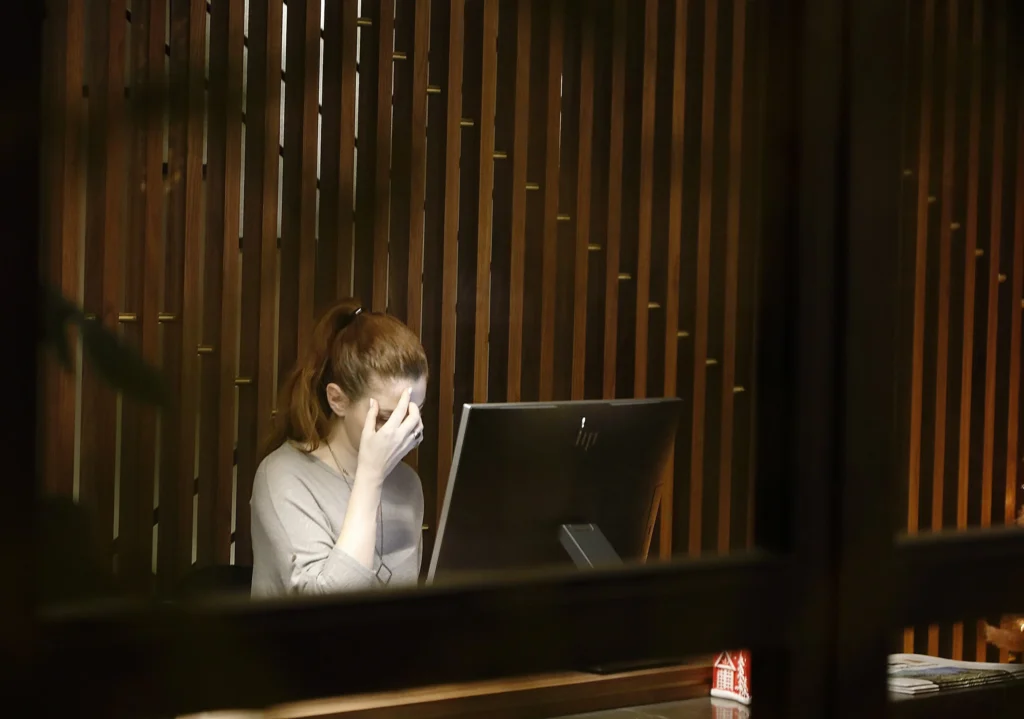
    A woman looking at her computer, frustrated.

    You might realize that you love streaming, but you alsoneed to love the content you’re streaming. I struggle to play the same game for long periods at a time—and usually when I quit, I quit forever. This doesn’t make me compatible to be a one-game streamer, as I will eventually want to quit it. I recently saw a lot of growth while streaming Apex Legends, and as soon as I moved to something else, I saw my follower count dropping. I’ve always identified as a variety streamer, but playing one thing for over a month led people to attach themselves to me who maybe wouldn’t have if I was playing something different week to week.

    If I continued playing Apex,I would quickly burn out and wind up stepping away—losing everything in the process. As it stands, moving away from Apex,I’m back to averaging similar views, but now my videos aren’t always on the same topic. I’m cultivating a following that enjoys me as a creator, and doesn’t care as much about the game I’m playing. This drives up my sustainability because I can go live playing anything and my regulars will still come to say hi. Even if it’s not a game they enjoy playing or watching, they still come by. If I drove myself to burnout, I’d lose everything—it’s critical that doesn’t happen.

    But, if you’re one of those people who has only ever played Call of Duty, and you play every Call of Duty game from the day it releases until the day the next one comes out, there’s an audience out there for you too.

    Maximizing Growth: Where Special Interests Meet Niche Audiences

    One thing I haven’t explored is how I can attract an audience of similarly analytical minds, who may help me see things I haven’t recognized yet—people who can work with me to see the inner workings of new games.

    If your special interest overlaps with an established niche, you may be able to capitalize on that to enhance growth. I understand that retro games have a fairly large niche audience, so if you’re discovering new things about retro games, there’s a lot of potential there. Speedrunning is another area that I know little about, but records are constantly being broken in 20-year-old games. This is where it probably helps to be a part of associated subreddits, Discord servers, or other community centres based around that interest.

    But what do you do if you haven’t identified an overlapping special interest yet?

    Finding and Focusing Your Content Superpower (Special Interest)

    You find it! You probably actually already have special interests, even if you haven’t realized it yet. There’s something out there that gets your motor running, and not in a weird way.

    Identifying your Core Interests

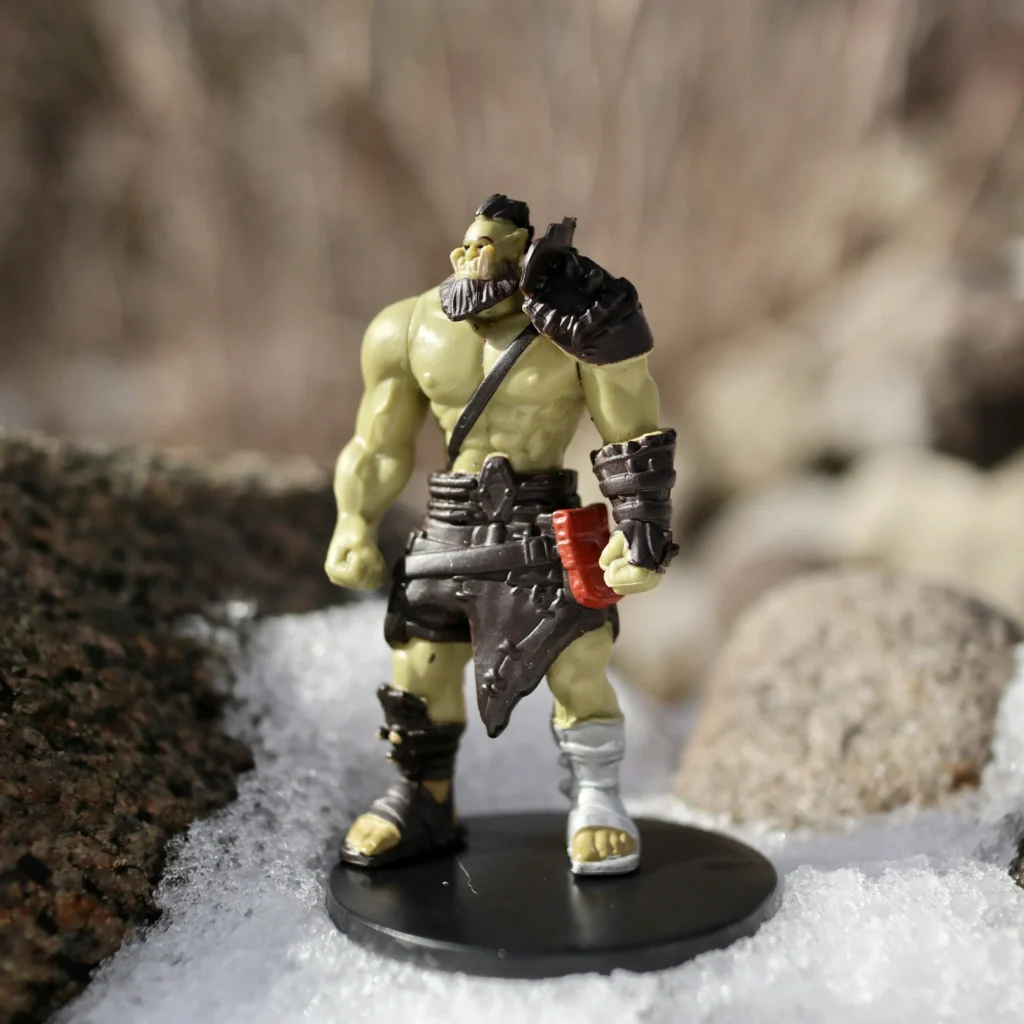
    An orc statue, like something you would see in a video game or tabletop game.

    What do you spend hours thinking about? Researching? Doing? When you go to bed, do you make a mental note about what you’re going to look up tomorrow morning when you get up? Do you sometimes get up in the middle of the night after waking up to a random thought, just to Google search and save the results for the morning?

    What topics do you loveto discuss? Whenever I heard colleagues discussing MMOs, I would try to join in the conversation because it was a topic I loved discussing. There was a time, when World of Warcraft was at its peak, and every new game that came out was the next “WoW Killer.” Games like Rift, Warhammer Online,and Aion.Even games like Tabula Rasaand Auto Assault tried to break into what World of Warcraft built. I loved them all. MMOs came out so fast in the mid-2000s, and they all had physical releases. I would race down to Future Shop on release days to pick up the newest game—they were all $60 back then, plusa $15/month subscription fee.

    When you think about areas where you may fit into a niche, like the aforementioned speedrunning, retro gaming, etc, what problems do you like to solve? A lot of speedrunning seems to be finding the next time-saving exploit or optimized route. Many MMOs offer customized builds, but you’re still bound by the strength of your equipment. Some games, however, may have lower-strength equipment with unique qualities that can make an otherwise-weak character much stronger. This is more common in single-player RPGs, where you might equip a Ribbon in Final Fantasyto become immune to afflictions, but some MMOs have dabbled in such systems as well.

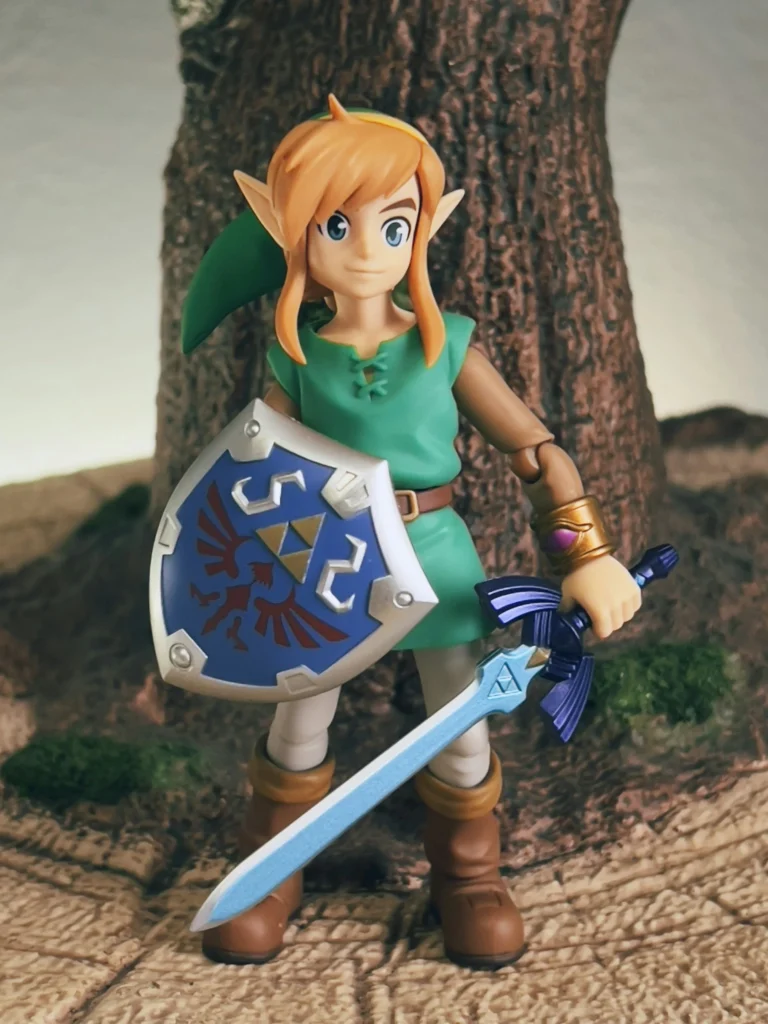
    Link, the hero of the Legend of Zelda series.

    I’ve talked about some of the very common, widespread content niches, but that doesn’t mean youhave to. Special interests can vary wildly, and the niches attached to them can be just as varied. The Legend of Zeldatimeline and branching realities were anybody’s guess before 2011, but games have come out since then, and many people online have their own version, modified versions, or deep explanations after extensive looks through the lore. When you add in a 10,000-year time skip that tries to merge all three timelines into one, as Jeffrey Parkin from Polygon notes, things get even more complicated (Parkin).

    The takeaway here is compelling content comes from a variety of sources—and you can be one of those sources if you focus your special interest in a way that can share that content with others.

    From Interest to Content

    Let’s roleplay for a moment. You are an RPG fanatic. You can’t get enough. You’ve played every Final Fantasy, every Dragon Quest, and every Persona game. You can speak in depth about the story, the characters, and the mechanics of every game you’ve ever played. What you liked, disliked, how you beat the secret boss, what level you were. It’s all right there. How do you turn that into content?

    Are you going to do tutorials? “Final Fantasy VI’s Materia System Explained in Five Minutes.” Reviews? “Persona 5 Royal is an excellent addition to the base game that enhances nearly every good part of Persona 5. The third semester felt a little weaker than the first two, due to the limited social activities and focus on one specific storyline, but experienced players likely won’t need that extra time anyway, so it doesn’t detract from the experience for most.” Maybe analyses? “Final Fantasy Tactics and Final Fantasy XII take place in alternate universes, despite both being set in Ivalice, and here’s the proof.”

    If you’re looking at something like analysis, you might need multiple videos or articles to cover all of the topics. Can you break it into multiple pieces? Maybe you start with the history of Final Fantasy’smysterious judges? And use that explained lore to expand in a followup video, then you put a YouTube playlist of everything in order, and you put that at the top of your YouTube channel. You can use visual aids, diagrams, and structuring—even things like YouTube chapter markers can help organize things.

    Embrace Authenticity: Unmasking for your Audience

    A white mask with cut out eyes and a black paint splatter behind it.

    As a late-diagnosed autistic adult, I am all too familiar with the process of unmasking. A lifetime of learned habits and behaviours that needs to be undone. The first place I began unmasking was at home, and I’ll be damned if I’m going to mask on stream—my quirks, my strengths, my weaknesses, the faces I make and the songs I sing. They’re all part of the show, and I do it without shame or embarrassment.

    What does Authenticity mean for Autistic Creators?

    As a child and teenager, I spent hours in front of a mirror, practicing my smiles, so that the next time someone said, “Say cheese!” for a picture, I’d look normal—and not like a serial killer. This was an age before digital cameras, so it’s not like they could check and re-take the picture. I wouldn’t find out I’d done it again until the class photos came out, and there I am, at the back of the class (I was abnormally tall growing up), dead eyes and murder mouth.

    It took some time since my diagnosis to fully understand what the doctor meant when he told me that being autistic now means I was autistic growing up. But looking back and analyzing my behaviour, my interests, my social interactions, and it’s clear as day to me now. My internal monologue would constantly criticize me for not thinking the same way—people would ask me why I was different, or tell me I was weird. A Henry Ford article perfectly summarizes something I want to highlight: “Masking is a life skill [autistic individuals] develop to blend in with their peers” (Henry Ford Health Staff). While other kids were building other life skills, the autistic kids were focusing their efforts on basic survival. We seemed weird or wrong or broken, because we were. We were effectively stunted in our development due to the intense pressure to mask our authentic selves.

    Your content is your portal to authenticity. It’s not about being perfect. It’s not about a performance—even if it is sort of like performing. It’s about letting your natural communication style, your thoughts, and your quirks shine through. Even as I write this, I ask myself, am I putting too many personal anecdotes in this? Am I not including enough? Will people even read this? But you know what? I will read this—and I will post this—and I will be proud of myself for contributing somethingto the community that I feel has value. And one day, someone will read this article, extract value out of it, and hopefully email me a note about how they got value out of it.

    How to be Authentically You

    Some 3D text arranged to say "You are you"
    • If you don’t feel comfortable looking directly at the camera during a livestream, don’t. Position your camera on the opposite side of your monitor from your chat so it’s obvious when you’re looking at chat—but you absolutely needn’t look directly into the lens to connect with people.
    • Be direct and clear—the same way you would appreciate people communicate with you. If you use jargon, make sure you define it—someone will be there who is there because it’s you,not because they like the subject. They won’t understand the jargon, and we don’t want to alienate the people who like us for who we are.
    • Embrace Your Quirks. If you use fidget toys, make that a part of the show. If you have unique mannerisms that reveal feelings—you squeal when you’re excited, you bounce when things get intense—embrace those moments. Define those moments. Bring your audience on a journey of understanding exactly what makes you special. Consider things like an animated bounce emote so when things get intense, your chat knows it’s time to start spamming your bounce emote. They can celebrate you while you work through feelings that might have otherwise made you self conscious. But by owning and embracing it, you make it part of the experience, and you say, “Yes, this is me. And this is why I’m awesome.” I stick my tongue out when things get intense, and as I write this, I’m realizing I need an emote of me sticking my tongue out for just this purpose.
    • Set Expectations. I identify my autism in my social media and on my Twitch and YouTube channels, though I don’t highlight my quirks in my about me sections. I do highlight inclusivity in my rules, but I don’t even truly know all of my quirks yet. If I notice something getting noticed by my chat, I may elect to add a note about it, but for now, things are pretty chill. If you have much more noticeable quirks, you might want to identify them early so people aren’t surprised.
    • Your Passion Will Shine. As you embrace authenticity, your enthusiasm and passion for your special interests will shine through and create entertainment for your viewers.

    Building Your Community: Connecting with your Niche Audience

    A group of young people LARPing (live action roleplay)

    By focusing on your special interests and being authentic, you will naturally attract an audience who appreciate that type of content. Remember, though, that your audience might not be on just one platform—and may be underrepresented on a given platform. For example, X (formerly Twitter) has recently become a less desirable platform for those with disabilities—many of whom have migrated over to Bluesky—if they haven’t given up social media altogether. Eric Garcia highlighted some of the policy changes at Twitter, where the accessibility team was laid off in late 2022 (Garcia). Later, in early 2025, many Twitter users moved over to Bluesky, with a huge push from Reddit, as subreddits began banning Twitter links en masse. By putting yourself out there on multiple platforms, you increase the reach your content has—though you also increase the amount of time and effort required to contribute, so a healthy balance is required.

    Communities Thrive with Shared Interests

    By creating content that drives conversations to the areas you are interested in, you get to have meaningful conversations on topics you are both interested and knowledgeable in, making for more educational and impactful content.

    If you create video content on, YouTube or TikTok, your comment section is a living, breathing beast. Engaging with your commenters, especially those who post in the first 24 hours of a video, gives every video the feeling that you are engaged in an ongoing conversation. If you write for a blog, replying to comments or emails you receive goes a long way in solidifying your authenticity and passion. Something like Discord may also benefit you—I struggle with the live chat and instant access of Discord. I like when I’m offline, that I control when and where I reach out to people. But for someone skills in community management, Discord can be a tremendous asset to your content platform, as it can be a home for your most passionate members.

    Niche communities are often both inclusive and engaged. If you find yourself overlapping with one of these communities, you are in for a treat—as they will likely welcome you and everything about you. If you don’t appear to be a part of any niche at first, keep an eye out—maybe you’ll be surprised to learn there is a community of from-scratch croissant bakers out there who just haven’t found your recipes yet.

    Your unmasked and authentic approach to content will naturally create a space where people feel comfortable being themselves—an inclusive community where they can be their authentic selves as well. Make sure you embrace that inclusivity with appropriate behaviour and rules for your community.

    Your Greatest Strength is Your Voice

    Trying to conform to what society expects of us is exhausting and unnecessary—especially online. Be yourself, and let your true voice shine through. Hyperfocus, depth of knowledge, info dumping—these quirks become strengths: valuable and engaging. Embrace them and others will embrace you.

    Stop trying to fit into a society not built for you. Your unique autistic voice, empowered by your special interests, is what the content world needs.

    References:

    1. Special Interests in Autism, Kaitlin Schifano, Prosper Health
    2. Legend of Zelda timeline, explained, Jeffrey Parkin, Polygon
    3. Autism Masking Is Common. Here’s How to Recognize and Offer Support, Henry Ford Health Staff, Henry Ford Health.
    4. Elon Musk is locking Twitter’s disabled users out of his ‘town square,’ Eric Garcia, MSNBC